Shut your water off
If water is running in your house right now, this is the page you need and not the booking form. Do these three things, in this order. Then call.
-
Find the main shutoff
In a Detroit basement it is on the front wall, within a few feet of where the pipe comes through, and the meter is right behind it. If you are on a slab or in an apartment, the sections below say where to look instead.
-
Turn it all the way off
A lever handle takes a quarter turn until it sits across the pipe. A round wheel turns clockwise, several full turns, until it stops. Do not force a stiff wheel valve past the point it wants to stop — the stem snaps and then it is open forever.
-
Open the lowest faucet in the house
A laundry tub or a basement sink. That drains the pressure and the standing water out of everything above it, so the leak slows to a drip instead of emptying the pipes onto your floor.
Which valve do you have?
There are two, they close completely differently, and getting it wrong is how people end up with a broken valve and a wet basement. Turn each one to see.
Ball valve
A straight lever. A quarter turn and it is shut. Lever along the pipe is open; lever across the pipe is closed, and you can see which from across the room. This is what we fit.
Open — the lever runs along the pipe.
Gate valve
A round wheel. Several full turns, clockwise. Older, common in houses built before about 1980, and the one that seizes. If it will not move, stop — a snapped stem is worse than a leak.
Open — wheel backed off.
Where the valve is in your kind of house
Pick what you live in. All four are on this page whether or not the buttons work.
A house with a full basement
This is most of Southwest Detroit and most of Downriver, and it is the easy case. The service line comes through the front foundation wall, usually about a foot above the basement floor and often near the front porch. The first valve inside that wall is your main. The meter sits just past it.
If the basement is finished, look for a small access panel or a hatch in the front wall. Nobody is allowed to bury a meter behind drywall with no access, though people do it anyway.
A house over a crawlspace
The line comes up out of the crawlspace and the valve is normally just inside the floor above it — in a utility closet, beside the water heater, or under the kitchen sink. You should not have to go into the crawlspace to shut your water off, and if you do, that is worth fixing before you need it in January.
Crawlspace pipe is also the pipe that freezes. It is the least insulated run in the house.
A house on a concrete slab
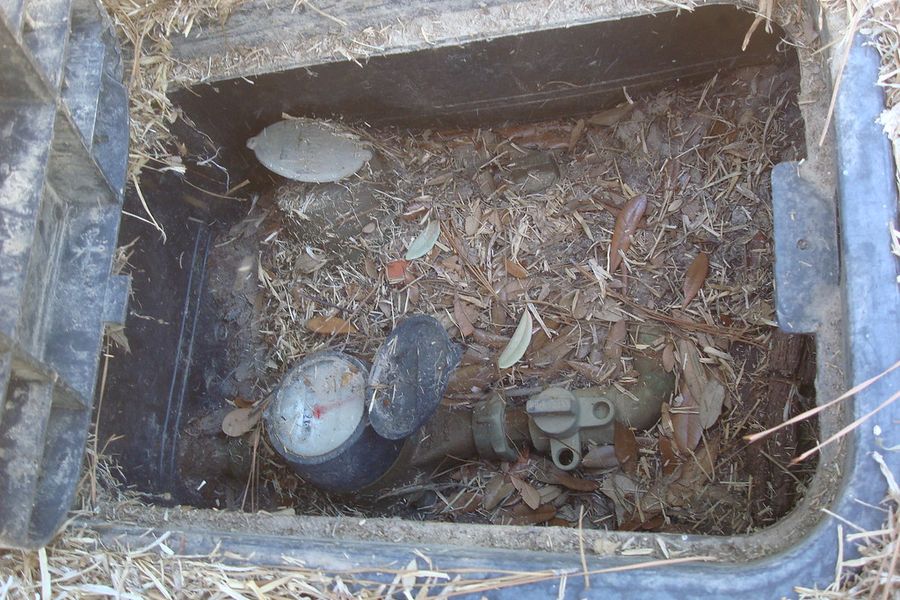
There is nothing under the floor to reach, so unless there is a valve in an outside wall box, your shutoff is the curb stop — a small round or rectangular lid in the grass between the sidewalk and the street.
It needs a curb key, which is a long T-handled bar. A screwdriver will not turn it and trying usually breaks the stop, which turns a free job into a paid one. If you do not own a key, call us or call the water department.
An apartment or an upper flat
You almost certainly cannot shut the building off, and you should not try. What you can shut are the angle stops under each fixture — two under every sink, one behind the toilet, and a pair at the washer. Turn those and most leaks stop.
If the leak is in the wall rather than at a fixture, the riser valve is in the basement or a service closet and it is the building manager’s to operate. Call them, then call us.
If you cannot find it or it will not turn
Do not keep forcing it. Two things are still open to you.
- The curb stop. A lid in the grass between the sidewalk and the street. It needs a curb key. We carry one, and so does the water department.
- Detroit Water and Sewerage Department. They can shut the service at the street. Their number is on your water bill and on their website; we are not going to print a number here that might be out of date when you need it.
While you wait: get everything off the floor, kill power to anything the water is heading for at the breaker rather than by unplugging it in standing water, and take photographs before you clean anything up. Your insurer will ask.
Once the water is off
The emergency is over and you are back to an ordinary repair, which means you have time to be careful about who you let in the house.
- Get a flat price in writing before anyone starts. Not a range over the phone, not an hourly rate.
- Ask for the license number and check it against the state register.
- Nobody needs a deposit for a repair, and nobody needs cash.
- If the answer to “what will this cost” is “we will have to see” twice in a row, that is your answer.