At the sale
A buyer’s inspector finds work that does not match the permit history. Now it is a negotiation item, priced by somebody who wants a discount, on a deadline you do not control.
You cannot see behind your walls and you should not have to take anyone’s word for what is back there. The permit record is the one piece of this that a stranger left in a public database with a date on it.
A contractor licensed by a municipality or by the State Electrical Administrative Board. Or the homeowner, for a single-family home they own and occupy or are about to occupy.
That is the entire list. It is worth saying out loud because the third category — a guy who does side work, a handyman, a relative in the trade, a contractor’s unlicensed helper — is the one most people actually hire, and it is the one the state does not recognize.
Licensing itself runs under the Electrical Administrative Act, Act 217 of 1956, which is why an electrical license is a state matter and not something a city invents locally.
The requirement is not a local policy or an industry preference. It is the condition on doing the work at all.
“A person shall not equip a building with electrical conductors or equipment or make an alteration of, change in, or addition to, electrical conductors or equipment without receiving a permit to do the work described.” Read the page →That is exactly why it works as a sales pitch. The consequences are all deferred, and they all arrive at a moment when you have no leverage.
A buyer’s inspector finds work that does not match the permit history. Now it is a negotiation item, priced by somebody who wants a discount, on a deadline you do not control.
An insurer investigating a fire looks at what was installed and when. Unpermitted work is not automatically a denial, but it is automatically a question you have to answer, without the record that would answer it.
The next electrician opens a box and finds work nobody signed. Now they are pricing the unknown, which is always more expensive than pricing the known.
Homeowners tend to picture a bureaucratic ordeal. On a normal residential job it is four steps and the only one you have to be present for is the inspection.
Before the work starts, not after. It names the licensed contractor, the address and the scope. In most of the communities we work in this is filed electronically and comes back the same week.
Anything the inspector needs to see stays visible. Nobody drywalls over a new circuit before the rough inspection, which is the single most common reason a job gets delayed by a week.
A municipal electrical inspector, not us and not anyone we pay. They check the work against the code the community has adopted. They can and do fail things. When that happens we correct it and they come back.
A closed permit is a permanent, public statement that a licensed person did this work on this date and an independent inspector approved it. That record outlives us, which is the entire point of it.
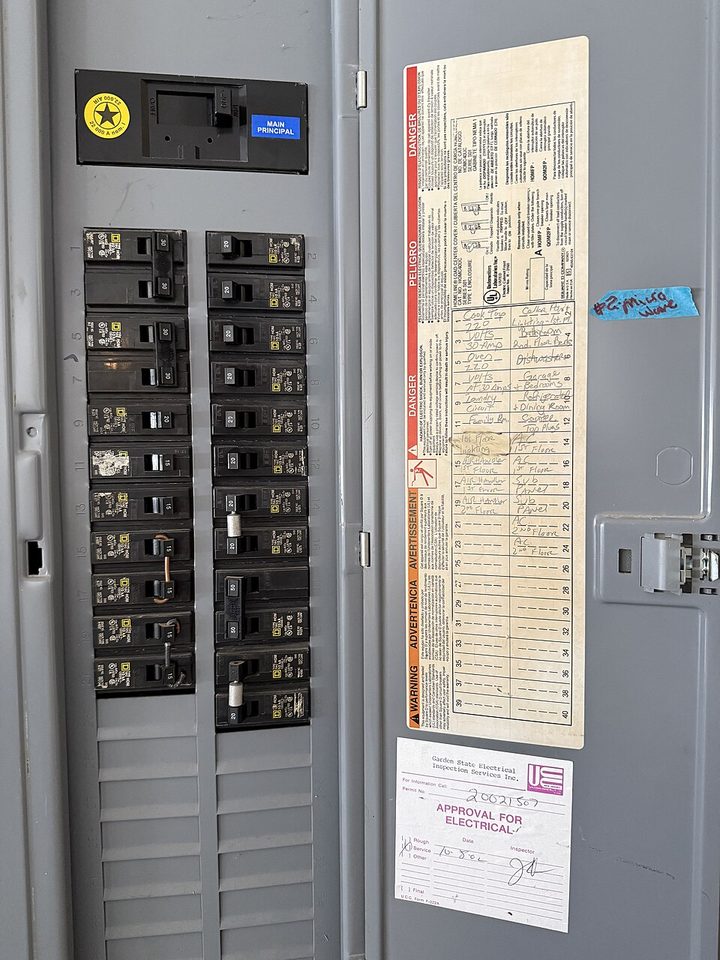
Open your own panel and look. If somebody pulled a permit for work on this house, there is generally a sticker in there with a number and a signature on it, and the date tells you when the house was last touched by somebody who had to answer to an inspector.
Next to it, if you are lucky, is the other thing worth having: a directory somebody filled in by hand, in the words the people who live here actually use.
The state runs a public license lookup and a public permit lookup. Neither requires an account, and neither is something a contractor can edit.
Ask every contractor bidding your job for their license number and the address of a recent permitted job. A licensed one will read the number off to you without pausing. Watch what happens with the ones who do not.
Electrical contractor license 6100000000, State of Michigan. Working in Ferndale since 2016.
Every job we do is permitted and inspected. Not most of them, and not the big ones. There is no version of our price list where skipping it is an option we offer you.
If a quote you are holding is cheaper than ours by roughly the cost of a permit, that is probably what the difference is.
If you own the house, live in it, and are doing the work with your own hands, Michigan lets you obtain the permit and be inspected exactly like a contractor. We would rather you did that than hire somebody unlicensed to avoid it.
The inspection is not an adversarial process. An inspector looking at a homeowner’s first added circuit is generally the cheapest expert opinion available in the state of Michigan, and they will tell you what is wrong before it is behind drywall.
Where this stops being a good idea is the list on the other page — the two jobs where being careful is not enough because there is nothing upstream of you to switch off.