One bench, two days a week open
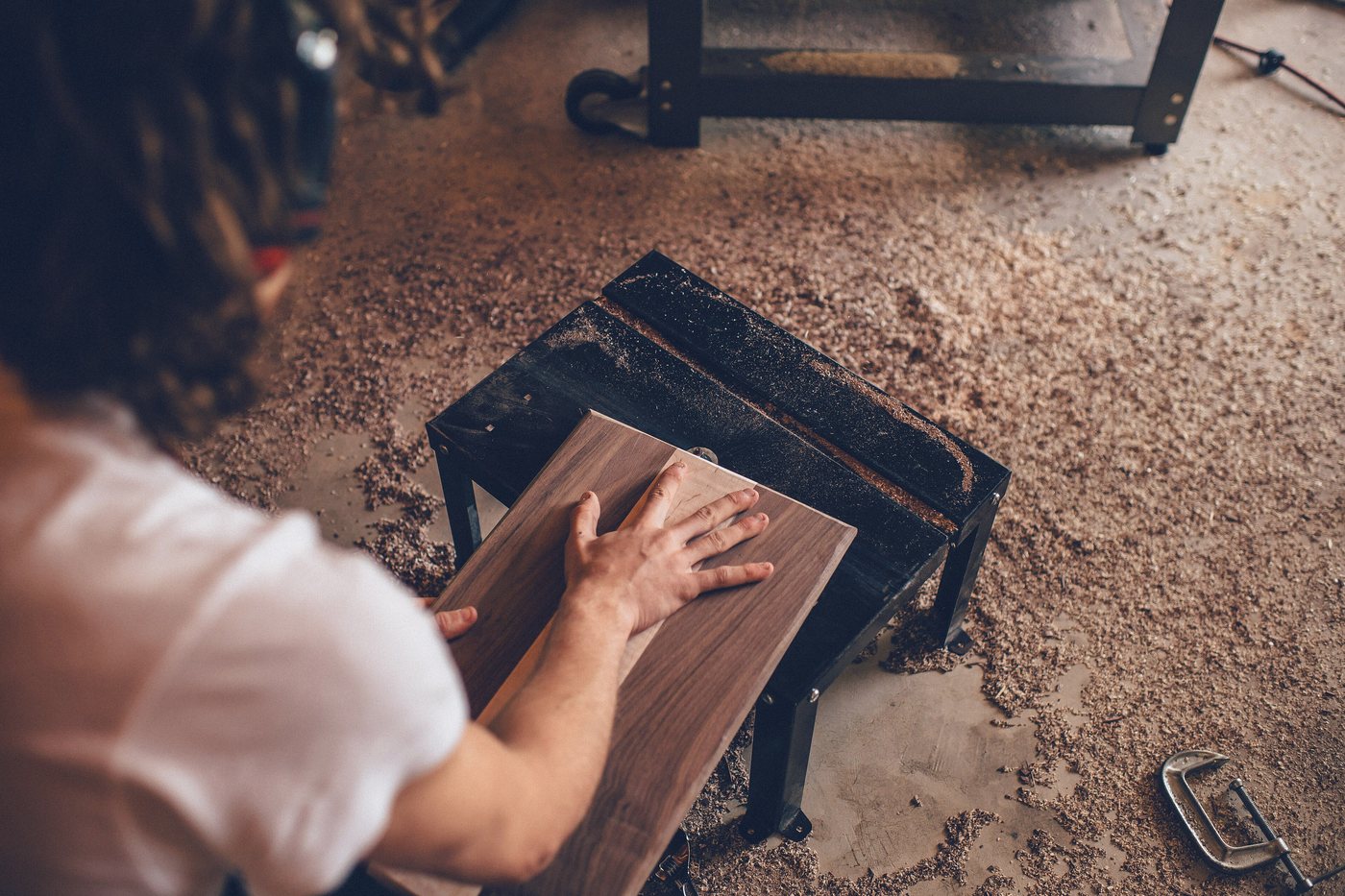
418 Godfrey Avenue SW, in a building that made office chair frames until 2003. There is one bench, one person at it, and usually four pieces in the book.
- Open
- Thursday and Friday
10 to 4 - Deposit
- Half
- Typical wait
- 10 wk
How a commission goes
You draw something on the commission page and bring it in, or you describe a room and we draw it here. Either way you get a dimensioned drawing and a price broken into its four parts before anything is agreed.
Half on order, which buys the timber. The rest on delivery. If you change the wood before the boards are bought that costs nothing, and if you change it after, it costs exactly what the boards cost — there is no restocking fee because there is nothing to restock.
Ten weeks is normal. Sapele adds two because it is not local. A hand-rubbed varnish adds three, and most of that is the piece standing still.
The single most common way a solid top is ruined, and it happens in the first winter.
Why a top has to be allowed to move
Wood does not move much along its length and it moves a great deal across its width. A three-foot white oak top in a Michigan house — humid August, dry January with the furnace running — will change width by something close to a quarter of an inch, twice a year, forever. It is not a defect and it cannot be prevented.
So the top is not fixed down. It is screwed to the bearers through slotted holes, and the screws slide. Fasten a solid top rigidly to a rigid frame and you have built a machine for splitting it, which is what has happened to most of the antique tables with a crack running down the middle.
This is also why the movement figure is on the wood page next to the price. Sapele moves about half as much as white oak. On a narrow console nobody would notice; on a four-foot-wide top it is the whole argument.
Thursday or Friday, 10 to 4
418 Godfrey Avenue SW, Grand Rapids. Ring first on any other day and somebody will probably be there anyway.