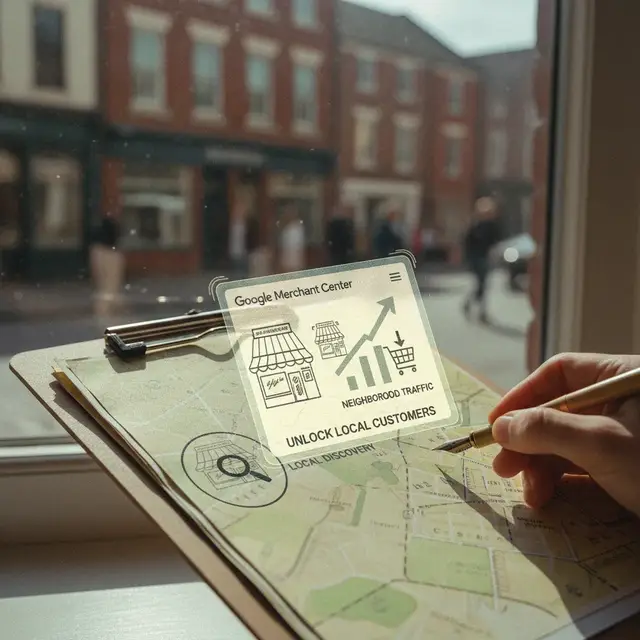
Shoppers in Midtown and Corktown are already on their phones searching for products while standing minutes from your door. If your physical inventory isn't synced to their search results, you are effectively invisible to the most qualified leads in the city. Google Merchant Center is the engine that closes this gap between a digital query and a physical transaction.
Key Takeaways
- Google Merchant Center syncs your physical inventory to search results, so shoppers in Midtown or Corktown can confirm an item is on your shelf before walking in.
- Local inventory ads put your store above general results with a "Pick up today" badge — competing on immediate convenience, not price alone.
- Map your Point of Sale data directly to Google's required schema and automate it; API integrations pushing updates every 15-30 minutes keep prices and availability honest.
- Data accuracy is the primary success metric: showing out-of-stock items as available damages customer trust and triggers automated penalties from Google.
Modern retail in Detroit demands that your storefront exists in two places at once: the street corner and the search results page. By leveraging local inventory ads, you provide real-time assurance that an item is waiting on the shelf. This is how you stop competing on price alone and start competing on immediate convenience.
Retailers who successfully bridge physical and digital inventory see a significant increase in local intent-driven visits. Research suggests that nearly 80% of shoppers will visit a local store if they can verify an item is in stock online first.
Setting up your feed requires technical discipline. You must map your Point of Sale (POS) data directly to Google’s required schema, ensuring that prices, availability, and store codes remain synchronized. This is not a "set it and forget it" task. It is a live pulse of your business. Without automated inventory updates, you risk showing items that aren't there, damaging the very trust you're trying to build.

Real-time inventory synchronization turns your physical shelf into a digital asset for neighborhood shoppers.
For businesses in dense corridors like Eastern Market, local inventory ads function as a competitive moat. When a customer searches for a specific tool, ingredient, or piece of gear, your store appears above the general results with a "Pick up today" badge. As discussed in our previous look at e-commerce strategies for Michigan retailers, the goal is to reduce friction at the point of decision.
Data accuracy is your primary metric of success. If your Google Merchant Center account displays an item as "in stock" when your shelves are bare, you degrade the customer experience and trigger automated penalties from the search platform. We recommend using API-based integrations that push updates every 15-30 minutes to maintain alignment with your store’s actual sales.
Beyond the technical setup, your local strategy should be part of a broader digital presence. If you're struggling to understand how these feeds interact with your current site architecture, revisit our guide on the importance of modernizing your business website. A robust local feed is only as effective as the landing page it points to.
76% of people who search for something nearby on their smartphone visit a related business within a day — Google consumer insights.
You have the products. You have the location. Now, you need the infrastructure to bridge them. Don't wait for your competitors to dominate the local search results while your inventory stays trapped behind your front door. The technology to dominate your local neighborhood is available, and it is time to deploy it.
Frequently Asked Questions
What does Google Merchant Center do for a local Detroit store?
Google Merchant Center syncs your physical inventory to search results, so shoppers in Midtown or Corktown searching on their phones can see your product is in stock minutes from where they're standing. It closes the gap between a digital query and a physical transaction.
How do local inventory ads help my store compete with bigger retailers?
When a customer searches for a specific tool, ingredient, or piece of gear, your store appears above the general results with a "Pick up today" badge. In dense corridors like Eastern Market this works as a competitive moat, letting you compete on immediate convenience instead of price alone.
How often should I update my Merchant Center inventory feed?
This is not a set-it-and-forget-it task; the feed should be a live pulse of your business. Use API-based integrations that push updates every 15-30 minutes so prices, availability, and store codes stay aligned with your actual sales.
What happens if Google shows my items in stock when they're sold out?
Showing items that aren't on the shelf degrades the customer experience and triggers automated penalties from the search platform. Data accuracy is your primary metric of success, which is why automated inventory updates from your POS system matter.
Ready to sync your inventory and capture local traffic?
We build the integrations that link your physical store to the digital world. Let’s get your products found by the people walking past your door.
Start a Project