Most proposals take too long. Not because the ideas are hard — because the writing is. A typical foundation grant proposal takes 3 to 8 hours to draft from scratch. A federal application can run 40 hours or more. That time isn't being spent thinking about strategy, impact, or which funders are the right fit. It's being spent formatting budget tables, rewriting the same organizational history paragraph for the twelfth time, and moving words around a page that already knows what it wants to say.
Key Takeaways
- Using AI to write proposal first drafts cut average time per proposal from 6.4 hours to 2.1 hours — a 70% reduction — allowing the same team to submit 14 proposals in a month instead of the typical 5 to 6.
- The bottleneck in most grant programs isn't ideas or relationships — it's bandwidth. AI solves the bandwidth problem by owning structure, boilerplate, and budget narratives while humans supply community voice and funder relationship signals.
- Brief quality determines output quality: when specific community data, participant quotes, and funder history go into the prompt, that context comes back in the draft. Vague briefs produce generic proposals.
- In the 30-day experiment, the total funding amount requested tripled to $340,000 with no additional staff cost, and two approvals were confirmed during the period.
The question worth asking: what happens if you hand the drafting to AI for 30 days? Not as an experiment in replacing your team — as a deliberate attempt to recover the hours that shouldn't require a person, and redirect them toward the work that does.
The Setup
The experiment was straightforward: for one month, every proposal started with an AI-generated first draft. No exceptions. The AI was given a project brief, relevant program data, the funder's stated priorities, and examples of previously successful proposals as reference. The output was treated as a first draft — edited, refined, and reviewed by a human before submission. The goal wasn't a fully automated pipeline. It was to understand exactly where in the proposal process AI actually earned its keep.
The rule was simple: AI writes the shell, humans fill the soul. Whatever the AI couldn't produce — community context, relationship signals, lived program knowledge — that stayed human. Everything it could produce faster than a blank page, it owned.
Week One: Friction — and the Fix
The first two proposals came back structurally complete but thin where it mattered. The organizational boilerplate was polished. The budget narrative was clean. The problem description was technically accurate. But the community context — the specific voices, relationships, and local dynamics that funders actually respond to — wasn't there. The AI had written a proposal. It hadn't written the proposal.
The fix wasn't to do less AI. It was to brief it better. Specific community data, direct quotes from program participants, names of community partners, notes on what the funder had funded previously, and what made this program different from every other application in their inbox — when that information goes into the prompt, it comes back in the output. By the end of week one, the drafts were passing the first human review with substantially less editing needed.
By Week Two, the Math Starts Working
Once the briefing process was consistent, the time savings compounded fast. A proposal that previously took 6 hours now took under 2. The AI handled structure, organizational background, program description, budget justification framing, and cover letters. The human handled community voice, funder relationship signals, final review, and submission decisions. In a single week, the team submitted more proposals than it typically managed in three weeks — and the freed hours went toward funder research and relationship-building, which improved the quality of the next round of briefs.
The bottleneck in most grant programs isn't ideas or relationships — it's the hours spent getting words on the page.
What the AI Got Consistently Right
Across 30 days and 14 submitted proposals, the AI reliably delivered on a specific set of tasks — the ones that eat time without requiring the institutional knowledge that only lives with the people doing the work:
- Opening narratives and executive summaries built from a one-paragraph brief
- Program descriptions drafted from bullet-point notes — organized, clear, funder-appropriate
- Budget justification language derived directly from spreadsheet line items
- Organizational history and background — boilerplate that every proposal needs and no one enjoys writing
- Funder template formatting — adapting content to specific application formats and word limits
- Follow-up emails and acknowledgment letters after submission
These aren't peripheral tasks. In a typical proposal cycle, they account for 60 to 70 percent of the total writing time. Recovering that time and redirecting it toward the 30 percent that actually requires human judgment is the entire value proposition.
What Still Needed a Human in the Room
The AI doesn't know your community. It doesn't know why this funder specifically, what relationship you've been building with their program officer, or what happened in last year's cohort that you want to reference. The following never left human hands — and shouldn't:
- Community voice — lived experience, resident quotes, specific local context
- Funder relationship signals — existing partnerships, shared history, personal connections
- Equity and sustainability framing that reflects actual program conditions, not templates
- Risk assessment — what could go wrong and how you've accounted for it
- Final review and submission authority — a person who knows the program reads every word before it goes out
The AI writes the proposal. Humans own it. That distinction matters not just for quality, but for accountability to the funders and communities you're serving.
The 30-Day Numbers
Two approvals confirmed during the period. Three more still under review at close. The total amount requested in 30 days was approximately three times the typical monthly output — with the same team size and no additional staff cost.
The Tool Behind It: Grant Flow
Grant Flow — AI-Powered Grant Writing & Pipeline Management
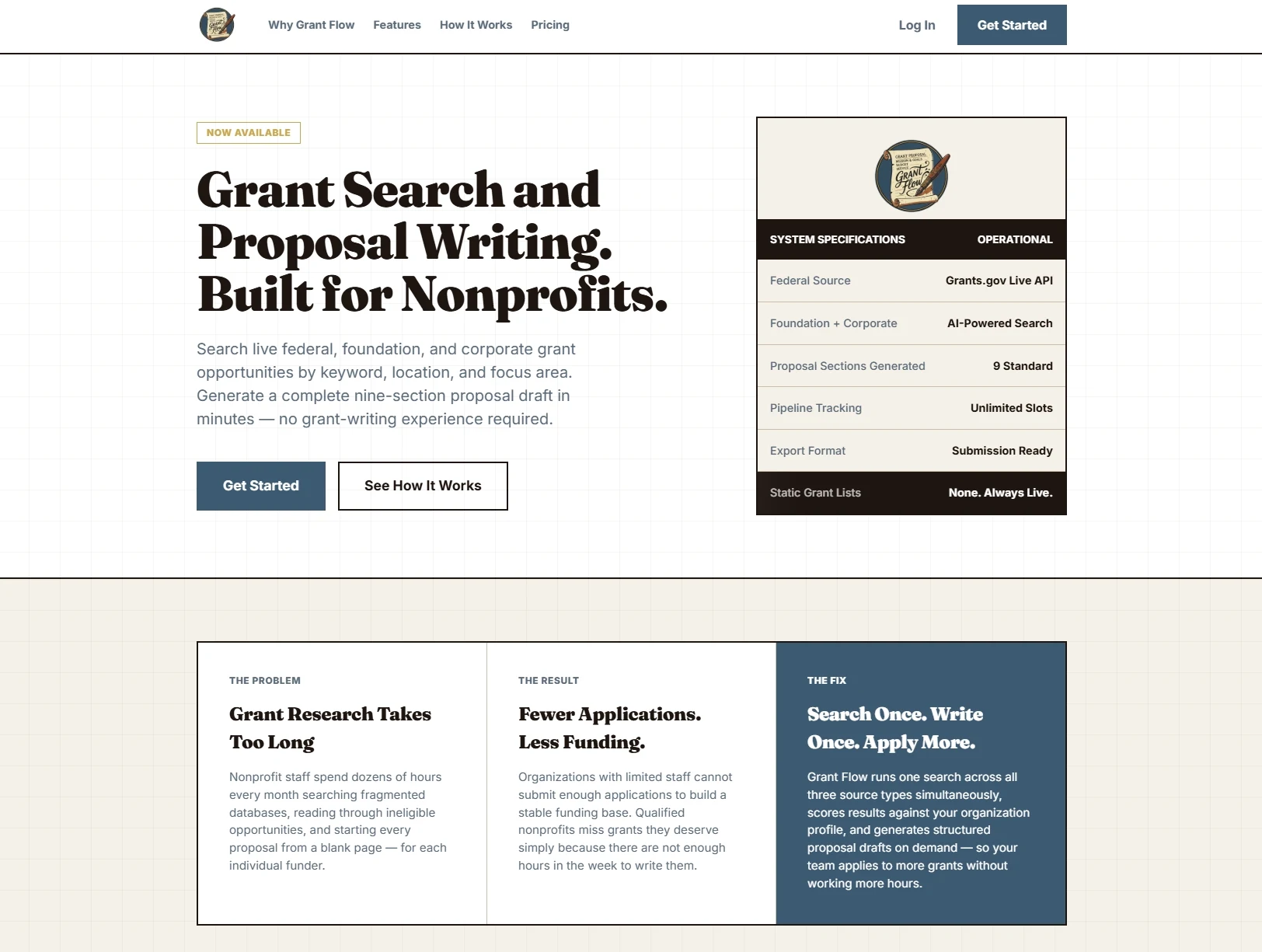
Grant Flow is built specifically for nonprofits and development teams managing grant pipelines. It combines AI-assisted proposal drafting with submission tracking and deadline management — so you're not just generating proposals faster, you're tracking where every opportunity stands, what's coming due, and what's been submitted. For organizations currently managing grants through spreadsheets and shared drives, Grant Flow changes how the entire operation runs: from discovery to draft to submission to outcome tracking.
Explore Grant Flow →Ready to put this into practice? Visit our AI workflow automation page to see how we work.
The Real Takeaway
The 30-day experiment proved something specific: the bottleneck in most grant programs isn't ideas, relationships, or even strategy. It's bandwidth — the hours consumed by tasks that don't require the judgment, relationships, and community knowledge your team actually has. AI solves the bandwidth problem. The humans it frees up solve everything else.
If your organization is submitting 5 proposals a month and could be submitting 14 — with the same team, the same relationships, and better-researched briefs going in — the question isn't whether to try it. The question is how long you're willing to wait before you do.
Frequently Asked Questions
Can AI really write grant proposals good enough to submit?
AI handles the structural skeleton well — organizational background, program descriptions, budget justification language, and funder template formatting. What it cannot supply is community voice, lived experience, and funder relationship signals. The rule from the experiment was simple: AI writes the shell, humans fill the soul. Every proposal still received human review before submission.
How do I brief the AI so the drafts are actually useful?
Brief quality determines output quality. Give the AI specific community data, direct quotes from program participants, names of community partners, notes on what the funder has previously funded, and what makes your program different from other applications. When that information goes into the prompt, it comes back in the output — vague briefs produce generic proposals.
What parts of a proposal should never be left to AI?
Community voice, funder relationship signals, equity and sustainability framing that reflects actual program conditions, and risk assessment should stay in human hands. Final review and submission authority always belongs to a person who knows the program. These elements account for roughly 30% of writing time but carry the most weight with funders.
How much can AI realistically increase our grant submission volume?
In the 30-day experiment, an organization that typically submitted 5 to 6 proposals per month submitted 14, tripling its output with no additional staff. The freed hours — 60-plus hours recovered across the month — were redirected to funder research and relationship-building, which improved the quality of briefs going into the next round of proposals.
Stop leaving proposals — and funding — on the table.
Grant Flow gives nonprofits the AI drafting, pipeline visibility, and deadline management to compete for more funding without adding headcount. Built by Iron Digital for organizations that can't afford to miss opportunities.
See Grant Flow →