
Updated September 23, 2026 · Editorial review by Iron Digital MI
← Back to BlogWhen we evaluate why businesses fail to grow, we look at the usual suspects. We scrutinize product pricing, dissect copy quality, evaluate traffic sources, and criticize sales collateral. Yet, the single most destructive variable in modern customer acquisition has nothing to do with what you offer or how much it costs. It has to do with the clock.
Many small business owners operate under the comforting illusion that replying to an inquiry within a business day is acceptable. They believe that a response sent at 4:30 PM to a lead submitted at 9:00 AM demonstrates diligence. It does not. In the digital economy, that nine-hour gap is an absolute eternity. Your lead did not wait around for your call; they moved on, found a competitor who answered instantly, and booked the job before you even opened your email client.
Key Takeaways
- Speed beats price: The business that contacts a prospect first wins the deal in the vast majority of cases, regardless of slight pricing differences.
- The five-minute rule: Your probability of successfully qualifying a lead drops dramatically if you delay response beyond the first five minutes.
- Automation is the cure: You can shrink your response window down to seconds without hiring a receptionist by putting simple SMS and lead-routing systems in place.
The Mathematics of the Five-Minute Window
Speed to lead is not a matter of polite customer service; it is a game of pure probability. If you analyze consumer behavior, you will find that the value of an inbound lead decays on an exponential curve. Within the first five minutes, a prospect is actively engaged with your brand. They are sitting at their computer or holding their mobile phone. They remember exactly what problem they were trying to solve when they filled out your form.
If you call them back within this five-minute window, you catch them at peak cognitive alignment. They do not have to search their memory to recall who you are or why they reached out. If you wait thirty minutes, the probability of connecting with them drops significantly. If you wait an hour, they have already stepped into a meeting, started driving, or moved on to another task. By the time you call them back three hours later, you are an unwanted interruption, and your chance of closing the deal has collapsed.
| Response Window | Conversion Likelihood | Prospect Sentiment |
|---|---|---|
| Under 5 Minutes | Maximum (~80%) | Highly impressed, stops searching immediately |
| 5 to 30 Minutes | Moderate (~30%) | Open to talking, but likely still searching |
| 1 to 4 Hours | Low (~10%) | Probably booked with a competitor already |
| Next Business Day | Dead Lead (< 2%) | Irritated or has forgotten who you are |
This reality is especially true for businesses looking to expand their footprint. Whether they are seeking home service inquiries or organizing local service requests, prompt digital communication is vital. This instantaneous local intent matches the pattern of growth we are seeing as businesses drive the expansion into Detroit's neighborhoods where physical proximity requires digital speed.
The Psychology of the "In-The-Moment" Buyer
Why does speed determine the winner of a commercial transaction so decisively? To understand this, you must look at the psychological state of a searcher. When someone experiences a friction point—such as a leaking roof, a broken commercial HVAC unit, or a desperate need for a marketing plan—they are in a state of high anxiety. They want that anxiety relieved immediately.
They go to Google, run a search, and click on the top three or four organic listings. They fill out a form or call the phone numbers listed on the screen. The first business to pick up the phone, or send an immediate personal text message, acts as an emotional release valve. The prospect stops looking because their search has successfully ended. They have found someone who acknowledged their problem. Even if your competitor's quote is ten or fifteen percent higher than yours, the buyer will often pay that premium simply because your competitor relieved their search anxiety first.
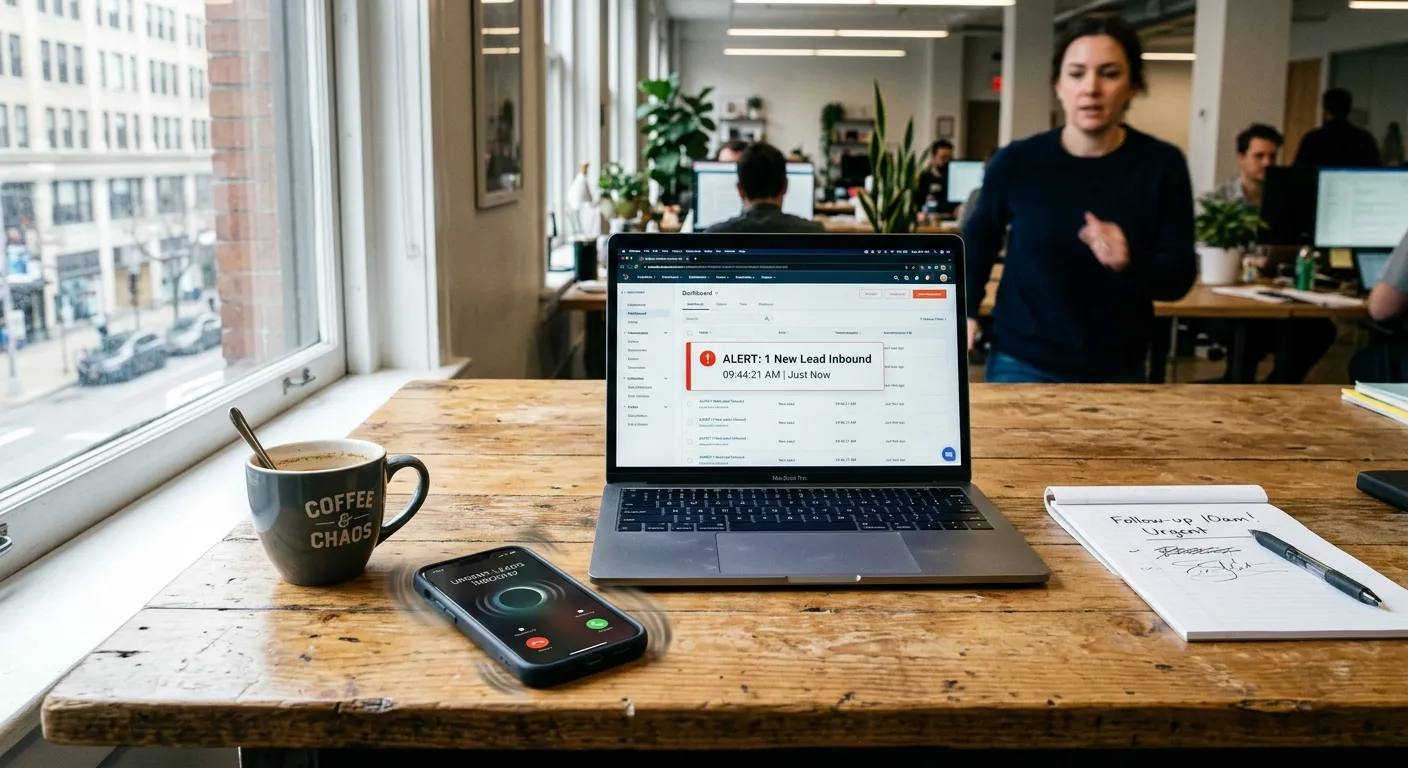
Answering a prospect's call or text within the first five minutes can increase your closing rate by several orders of magnitude.
Why Most Businesses Fall Short
If the data is so incredibly clear, why do the vast majority of organizations continue to let inquiries languish? The problem lies in their operational systems. Most companies treat leads as administrative tasks to be organized, categorized, and dealt with in batches. They route form submissions to a general info@ email address that is checked twice a day by an overworked manager. This creates a massive disconnect.
In an era fueled by downtown Detroit's ongoing commercial revitalization, local merchants must match their sleek physical storefronts with equally responsive digital communication loops. If your organization relies on human intervention to manually review every single submission before any contact is made, you will never meet the expectation of the modern customer. You are trying to solve a speed problem with human labor, which is both expensive and incredibly slow.
Stop Hiring, Start Automating
The standard reaction to a speed-to-lead problem is to assume you need to hire more staff. Business owners look at their budgets, realize they cannot afford to pay an administrative assistant to sit by the phone twelve hours a day, and resign themselves to slow response times. This is a fundamental mistake. You do not need more employees; you need better digital infrastructure.
By implementing simple automated systems, you can ensure that every lead gets touched within thirty seconds of submission. According to various SMB software industry surveys in 2023, automation can save small business owners an average of 10+ hours per week on repetitive administrative tasks. More importantly, it ensures your response times are consistently flawless, running in the background while you are on a job site, in a meeting, or asleep.
To fix your reply window today, implement these structural changes in your lead intake pipeline:
- Deploy Instant SMS Responders: When a user fills out a contact form, your system should immediately send an automated text message. It should be written in plain text, look personal, and invite an immediate reply. A message as simple as, "Hey, this is Ron from Iron Digital. I saw your estimate request. Let me look at our calendar—what is your address?" converts at an incredibly high rate.
- Implement Phone-Routing Automation: Use tools that automatically ring your field technicians or sales representatives the second a form is submitted. The system calls your phone, says "You have a new website lead, press 1 to connect," and instantly dials the customer. This connects you to the lead via telephone within sixty seconds of their submission.
- Ditch the Giant Intake Forms: Stop asking for thirty fields of information before you speak to a prospect. Every field you add to your form drops your conversion rate and slows down the transaction. Ask for three critical pieces of data: name, phone number, and their primary pain point. Get the rest of the details on the phone.
The Silent Killers of Lead Response
When audits are conducted on service-industry websites, common system design flaws consistently destroy conversion rates. If your platform is plagued by these oversights, you are actively burning your marketing budget:
- The "Thank You" Email Trap: Sending a generic email saying, "We have received your request and will get back to you soon" does not count as a response. It does not stop the customer from looking elsewhere. They want a conversation, not a digital receipt.
- Silent Forms: Forms that write to a database or a shared spreadsheet without triggering immediate push notifications or text alerts to your phone are useless. If you don't know a lead exists, you cannot respond to it.
- Treating Weekends Differently: Customers do not stop having emergencies or researching projects on Friday at 5:00 PM. If your website collects leads over the weekend but you do not reply until Monday morning, those prospects are long gone. Automated systems must run 24/7.
Ultimately, your digital presence is not a brochure; it is an active engine for generating revenue. The speed at which that engine processes inquiries determines how much fuel your business has to grow. Stop focusing entirely on driving more traffic to your site and start focusing on what happens the second that traffic decides to reach out to you. Optimize your systems, minimize your response times, and watch your closing rates soar.
Frequently Asked Questions
How fast does a local service business really need to respond to an online inquiry?
You should aim to respond within five minutes of receiving a digital lead. If you wait longer than thirty minutes, your chances of reaching and qualifying that prospect drop significantly. Most online searchers will simply move down the list and hire the first competitor who actually answers them.
Can I automate lead responses without sounding like a robotic spammer?
Yes, by writing plain-text, personal messages that sound like they were sent directly from your phone. An automated SMS saying, "Hey, I saw your request for an estimate, let me look at our schedule—what's your address?" feels completely human and instantly secures the prospect's attention.
What is the easiest way to capture and route incoming website leads to my phone?
The most effective setup is linking your website's contact form to an SMS alert system using lightweight automated workflows. When a prospect submits their contact details, the system instantly sends an alert to your phone via text, allowing you to click-to-call and respond immediately while they are still on your site.
Does response time matter more than having the lowest price for local services?
Absolutely, because speed relieves the customer's search anxiety. Most homeowners and commercial buyers do not want to spend hours comparing quotes; they want their problem solved immediately. The company that responds first establishes trust and momentum, which frequently allows them to win the job even if their price is higher.
Tired of losing ready-to-buy leads to faster competitors?
We build ultra-fast websites, optimized lead pipelines, and custom automated systems that capture and engage your prospects within seconds. Let's make your web presence your most active sales asset.
Start a ProjectReady to put this into practice? Visit our custom web development page to see how we work.