
Updated September 23, 2026 · Editorial review by Iron Digital MI
← Back to BlogThe allure of the out-of-state software vendor is easy to understand. Coastal agencies arrive in Southeast Michigan with slick slide decks, portfolios heavy with Silicon Valley consumer applications, and promises of rapid execution. For years, leadership teams in Detroit, Troy, and Grand Rapids looked outward, assuming that structural prestige in California or New York translated directly to technical competence on the ground.
But when these platforms go live, local manufacturers, tier-one automotive suppliers, and mobility innovators often find themselves bearing a steep, uncalculated financial penalty. Building business systems for Michigan’s core industries requires a deep understanding of legacy databases, logistics integrations, and real-time physical processes. When a remote team treats an industrial portal like a standard consumer storefront, the resulting friction creates massive operational drag.
Key Takeaways
- Industrial Domain Blindness: Remote vendors frequently fail to grasp the complex structural demands of Michigan's automotive, manufacturing, and supply chain networks, leading to mismatched software architecture.
- The Cost of Project Churn: Massive staff turnover in coastal agencies directly translates to a continuous cycle of billable retraining hours for the client as developers cycle off your project.
- Critical Support Friction: Timezone misalignment and the lack of a regional physical presence turn routine software updates and emergency debugging into multi-day communication events.
The Domain Blindness of Coastal Agencies
Let’s analyze the technical demands of regional operations in Michigan. If you manage a tier-one supplier in Pontiac or a third-party logistics provider near Metro Airport, your web platforms and database architectures are not isolated applications. They must integrate with material requirements planning (MRP) frameworks, electronic data interchange (EDI) setups, and automated shop floor components.
An out-of-state software developer sitting in an office in San Francisco often lacks the basic operational lexicon required to build these systems. They do not understand the absolute necessity of rigorous change management, nor are they familiar with the compliance frameworks governing local automotive supply chains. When they attempt to replace a stable, custom database connector with a generic cloud service because it fits their template, they risk halting your actual production processes.
This contextual blind spot is incredibly common. While coastal designers excel at creating consumer-facing interfaces that prioritize superficial polish, they struggle when forced to account for the harsh realities of industrial environments. A warehouse tracking application must be designed to load instantly on a ruggedized hand scanner used under poor warehouse lighting. It cannot be weighed down by bloated, slow-loading frameworks that require high-speed fiber-optic connections to function.
| Cost Factor | Out-of-State Tech Vendor | In-State Regional Partner |
|---|---|---|
| Average Base Hourly Rate | $200 - $350+ (Premium pricing structures) | $120 - $180 (Direct market rates) |
| Discovery & Training Phase | 4-6 weeks (Billed research on your industry) | 1-2 weeks (Ready to execute immediately) |
| On-Site Support & Integration | High flight, hotel, and per diem billing | Drive-in capability, same-day site visits |
| Long-term Staff Stability | Frequent churn (High coastal employee turnover) | High retention (Consistent developer contact) |
Hidden Financial Pitfalls of Out-of-State Contracts
The initial contract from a remote vendor might appear competitive on paper, but the true financial impact of software systems emerges in post-launch maintenance, troubleshooting, and continuous feature integration. When choosing an agency, businesses face structural issues that directly drive up long-term capital expenditure:
- Continuous Retraining Costs: High-tier tech hubs have notoriously high developer churn rates. When key engineers leave mid-project, the vendor bills you to get new developers up to speed on your business logic.
- Travel and Accommodation Markups: If your project requires physical implementation—such as testing software on an actual manufacturing line—you are forced to pay for plane tickets, hotels, and travel hours.
- Integration Delay Surcharges: Because remote teams do not understand regional infrastructure, their initial integration efforts often fail. They will bill you for extra hours to debug connections to systems they should have understood from day one.
This is particularly evident when regional businesses expand. For example, when managing distributed development teams from a Detroit headquarters, having a core technical partner in the same timezone who understands regional industrial networks is essential to prevent integration delays. When the core software platform is built by an out-of-state vendor who does not participate in local technical groups, aligning your internal systems with external partners becomes a continuous, expensive struggle.
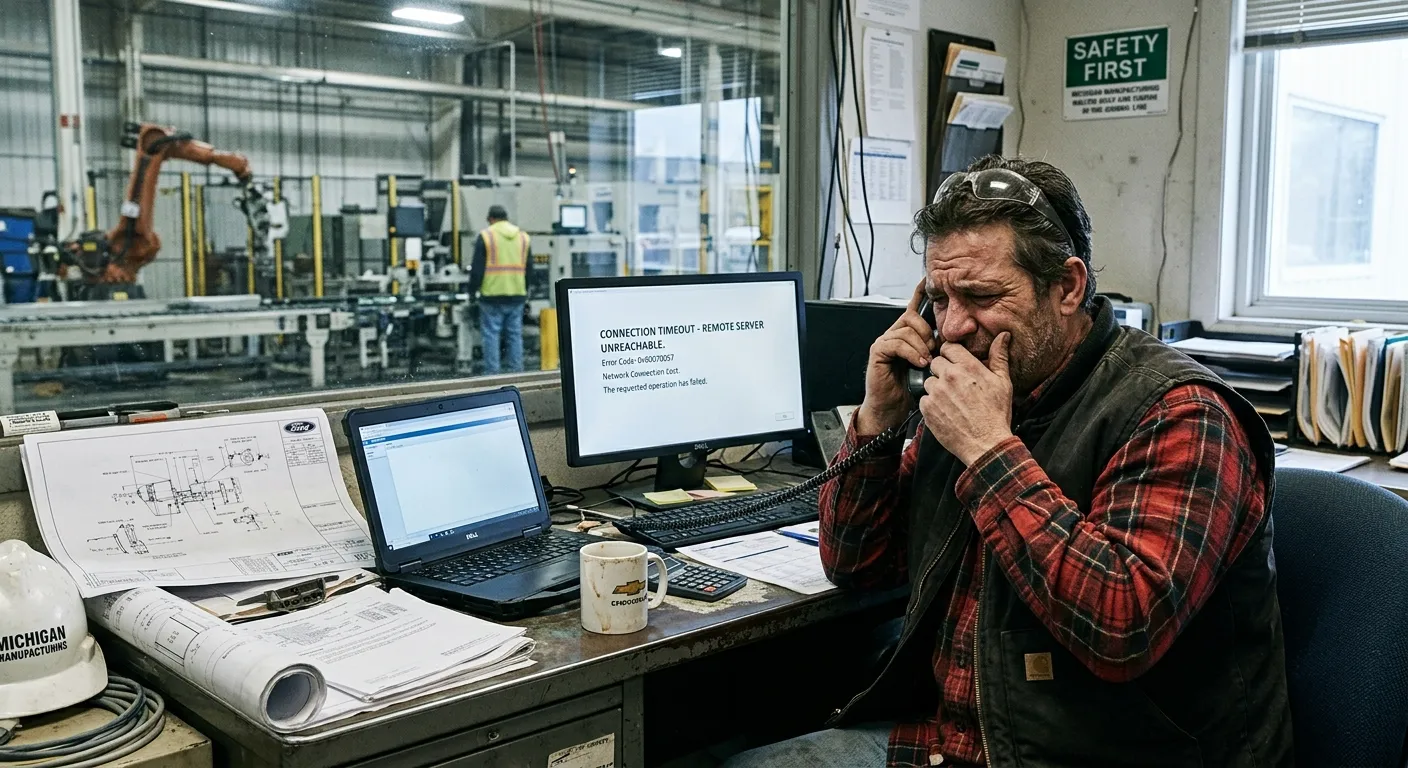
In-state software developers build tools directly for the physical reality of regional business environments, bypassing the communication gaps common in remote-only models.
Design Polish vs. Real-World B2B Utility
In B2B sectors, digital credibility is built through utility, reliability, and speed. A flashy user interface that crashes during peak transaction volumes or fails when network connectivity dips does not support your operations; it damages your business relationships. Many remote agencies prioritize complex animations and massive, uncompressed web files that degrade application performance in actual field use.
"Choosing a partner with a local presence isn't about regional pride; it's about risk mitigation. A regional developer understands the local business landscape, reducing the structural drag that out-of-state vendors introduce through timezone gaps and communication barriers."
The Speed of Proximity for Critical Support
When a critical tracking portal or production database encounters an issue at 6:00 AM on a Tuesday, you cannot wait three hours for a California-based technical team to log in. In the highly synchronized world of modern manufacturing and distribution, even an hour of digital downtime can cascade into severe financial penalties from your customers.
Having a regional technical partner changes this dynamic entirely. In-state developers work in your timezone, monitor the same regional networks, and can even travel to your physical facility to debug integrations on-site if necessary. This capability dramatically reduces your recovery window during critical software outages.
This fast coordination is key to how local firms operate. As we analyzed in our study on how Detroit's neighborhoods are the next digital frontier, technical investments must be closely tied to regional operations to deliver real value. Choosing a developer in Grand Rapids, Lansing, or Detroit ensures that your technology budget directly supports the local business community and your own bottom line.
By bypassing out-of-state vendors, you eliminate hidden timezone taxes, avoid expensive travel surcharges, and partner with engineers who understand your actual business environment from day one.
Frequently Asked Questions
Why does physical proximity matter for software development in Michigan?
Physical proximity allows developers to test software directly on physical systems, industrial equipment, or factory floor devices. It eliminates timezone delays for critical support and allows engineering teams to resolve integration issues on-site in hours rather than days.
How do out-of-state software vendors handle Michigan industrial compliance?
Out-of-state vendors typically lack familiarity with local automotive standards, APQP processes, and specific regional logistics requirements. They must build this knowledge base on your billable time, which often leads to project scope creep and timeline extensions.
What are the hidden costs of working with remote tech agencies?
Hidden costs include high travel fees for essential on-site visits, communication friction across different timezones, and the billable retraining of new developers due to the high staff turnover common in coastal tech hubs.
Can a local software company match the technical expertise of coastal firms?
Yes, Michigan possesses one of the highest concentrations of industrial, mechanical, and software engineers in the country. Local development firms offer deep technical expertise matched with specific domain experience that generic coastal firms cannot replicate.
Ready to build your digital infrastructure with a regional partner?
We craft high-performance websites, customized database integrations, and automated business workflows designed specifically for Michigan's industrial and business corridors.
Start a ProjectWant to explore how we construct robust web systems? Check out our regional web design services to learn more.