
If you run a local service business, you probably think of your website as a digital billboard. You paid a developer, put up some high-resolution photos of your team, listed your operational hours, and went back to running your day-to-day business. You assume that unless you are a multi-billion-dollar enterprise, your digital footprint is too small to attract legal trouble. But the legal reality of running a business online has changed dramatically over the last few years.
Today, web accessibility lawsuits have moved downmarket. What used to be a boardroom headache for massive retail chains has become a routine shakedown for local accounting firms, clinics, landscaping services, and contractors. Predatory legal practices have turned the Americans with Disabilities Act (ADA) into an automated enforcement system, where bots scan the web looking for easy targets. If your site has basic, easily avoidable design mistakes, you are likely sitting on a compliance ticking time bomb.
Key Takeaways
- Automated Shakedowns: Predatory firms use automated software to crawl local service websites, targeting small businesses with template demand letters that require expensive legal representation or swift settlement fees.
- Overlays Make You a Target: Quick-fix visual widgets do not solve core coding compliance issues. Instead, they flag your site to serial plaintiffs as an easy mark that has unaddressed compliance gaps.
- Fixes Are Cheap and High-Yield: Correcting contrast, adding explicit alt tags to images, and ensuring keyboard navigation protects you from litigation while significantly boosting search engine visibility and mobile conversions.
The Mechanics of the "Drive-By" ADA Lawsuit
In physical retail, "drive-by" lawsuits occur when an attorney visits a physical store solely to find minor, technical violations of ADA standards—like a mirror hung two inches too high or a ramp that is slightly too steep—and immediately files a lawsuit. In the digital space, this process has been entirely automated. Plaintiff firms no longer have to click through your website manually. They write basic crawler scripts that programmatically scan search engines for service providers in specific metro areas.
These scripts look for low-hanging fruit: websites missing standard alternate text for images, form fields without corresponding aria-labels, or links that cannot be navigated via a keyboard. Once the software flags a site with these structural errors, a pre-written demand letter is generated and mailed to the business owner. The letter typically demands a settlement between $4,000 and $15,000 to drop the claim. Faced with the prospect of hiring defense counsel at $400 an hour, most small businesses simply pay the settlement. It is a highly lucrative volume business for plaintiff law firms, and your local plumbing or legal business is the ideal target.
If you are operating in different communities, as we detailed in our analysis of Detroit's Neighborhoods as the Next Digital Frontier, you cannot afford to alienate local clients or invite expensive, distracting disputes that drain cash flow when simple preventative audits can secure your brand completely.
The Snake Oil of Accessibility "Overlays"
As these lawsuits have proliferated, a cottage industry of "quick-fix" solutions has emerged. You have likely seen them: small blue icons in the corner of a website that, when clicked, open a widget offering to adjust text size, change site contrast, or read the page aloud. These are known as accessibility overlays. For a business owner, they sound perfect. You pay $49 a month, copy-paste a single line of JavaScript onto your website, and assume you are legally protected.
In reality, these overlays are a liability. They do not alter your website's underlying code; they merely place a superficial visual layer over the top of it. Native assistive technologies, like screen readers used by visually impaired individuals, frequently clash with these widgets, rendering the site even less usable than it was before. More importantly, serial plaintiffs now search explicitly for websites that use these overlays. Having an overlay on your site is a clear signal that you know your website has accessibility issues, but chose to buy a cheap bypass rather than actually fixing the source code. It is an invitation to get sued.
The Common Violations (And the Math of Fixing Them)
The irony of digital accessibility is that the technical failures cited in over 90% of demand letters are incredibly simple to resolve. They do not require rewriting your entire website from scratch. Instead, they require a disciplined check of your site's fundamental structure.
| Common Violation | Technical Issue | How to Correct It | Resolution Cost |
|---|---|---|---|
| Poor Color Contrast | Light gray text on white backgrounds or orange buttons with white icons are illegible to visually impaired users. | Adjust CSS styling hex values to maintain a minimum contrast ratio of 4.5:1. | Extremely Low (Minutes of CSS adjustments) |
| Missing Alt Text | Screen readers skip essential images or read file paths like "IMG_4910.jpg" aloud to visually impaired users. | Add descriptive, natural alt attributes inside the image HTML tags. | Low (Simple CMS update) |
| Broken Keyboard Navigation | Users relying on the "Tab" key are unable to submit contact forms or navigate dropdown menus. | Ensure all interactive elements have visible focus indicators and use logical focus order. | Medium (Simple script review) |
| Unlabeled Form Inputs | Contact forms lack explicit <label> tags, leaving screen readers unable to declare what text belongs in each field. | Add native label elements or descriptive aria-label properties to all form inputs. | Low (Quick HTML edit) |
Developing a solid digital strategy requires looking beyond basic aesthetic trends; working with a dedicated web design partner allows you to address core accessibility compliance rules before they turn into expensive legal challenges.
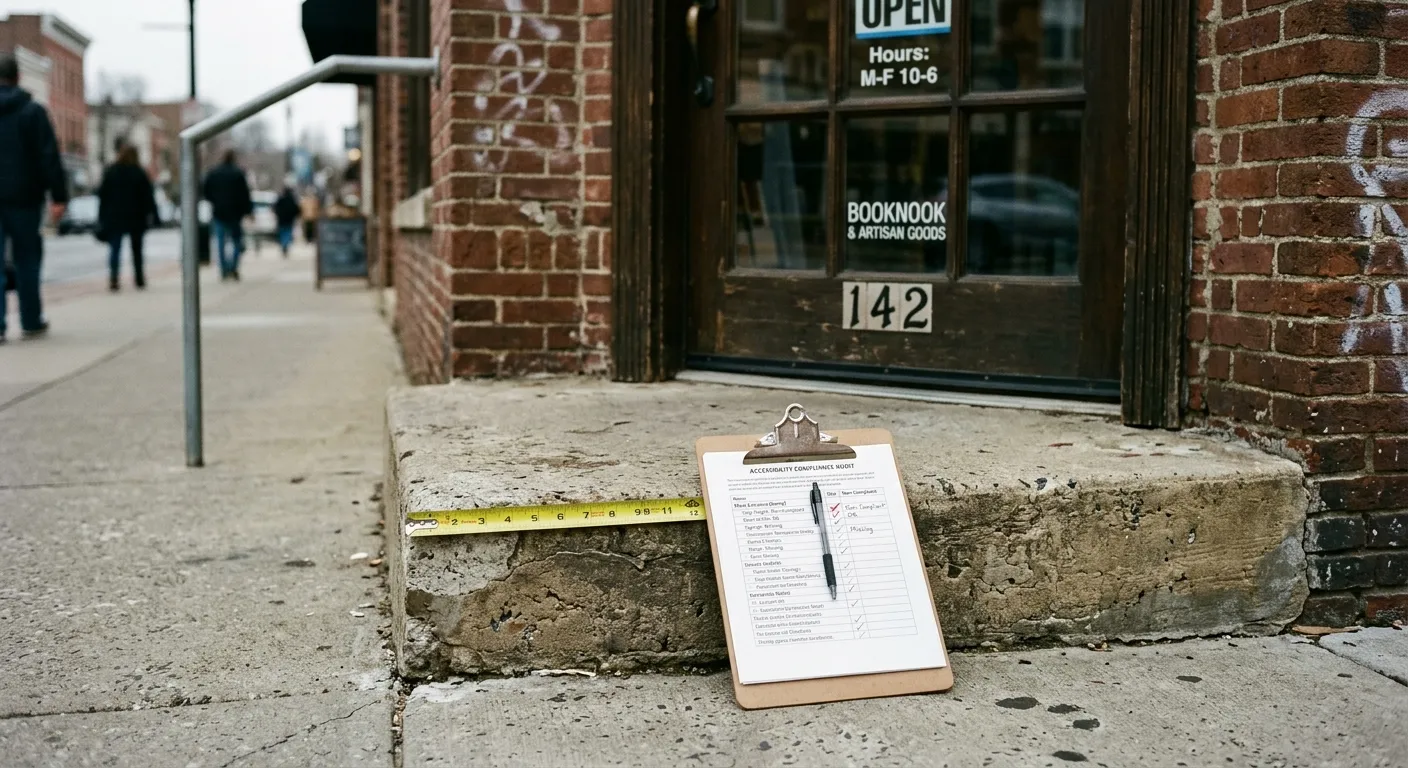
Fixing accessibility isn't about rewriting your entire site; it is about correcting key layout parameters that benefit every single user who accesses your business on a mobile device.
The Real-World Usability Benefit: Why Accessibility Wins Customers
When you fix these underlying technical issues, you are not just checking a box to satisfy state or federal regulators. You are directly improving the user experience for everyone who lands on your site, regardless of their physical abilities. Accessibility features are not special accommodations; they are the pillars of clean, professional web standards.
Consider how people actually use your website. A prospective customer looking for your service hours while standing outside in bright sunlight on Woodward Avenue will struggle to read your site if you have low color contrast. A contractor trying to read your pricing guide in a dark crawl space or a driver viewing your phone number on a dashboard mount relies on the exact same high-contrast, clean visual design that visually impaired users need.
"When you treat accessibility as a regulatory burden, you build a fragile, low-quality product. When you treat it as a foundational design standard, you build a website that functions flawlessly for every single human being, in any environment, on any screen."
The numbers back this up. In digital marketing, credibility and clean execution are directly linked to performance. Indeed, 75% of users admit to judging a company's credibility based on its website design (Source: Stanford Web Credibility Research, 2002). If a visitor cannot read your text because of poor contrast, or if your buttons are too small to easily tap on a mobile device, they do not give you the benefit of the doubt. They leave.
This drop-off happens in the blink of an eye. Research shows that it takes about 50 milliseconds for users to form a first impression of a website (Source: Lindgaard et al., Behaviour & Information Technology, 2006). If those crucial first milliseconds reveal a chaotic layout, tiny text, or broken navigation, the visitor's subconscious immediate reaction is negative. They bounce back to search results and choose a competitor.
Once a user leaves due to a bad interface, the damage is often permanent. Studies indicate that 88% of online consumers are less likely to return to a site after a bad experience (Source: research cited by Amazon Web Services, 2019). For a local service business, this means a high-contrast, accessible website is not just a shield against opportunistic lawsuits—it is a critical driver of actual business revenue and long-term customer retention.
A Simple Plan to Protect Your Business
Securing your business website does not require a massive development budget or months of technical auditing. You can eliminate the vast majority of your legal exposure by taking a few concrete, systematic steps today:
- Audit Your Site with Free Tools: Use free, industry-standard automated testing tools like Google Lighthouse (built into Chrome) or the WAVE web accessibility evaluation tool. These utilities instantly flag low contrast, missing alt text, and basic code structure errors.
- Remove Temporary Overlays Immediately: If you are paying for an accessibility widget or overlay plugin, disable it. It acts as a target for automated legal crawlers. Focus instead on fixing the issues directly in your website's underlying code template.
- Establish Clear Contrast Standards: Ensure that all text has a stark, readable contrast against its background. Avoid using light grays, yellows, or muted pastels for body copy. Stick to clean dark colors on light backgrounds or pure white text on dark design elements.
- Enforce Keyboard Accessibility: Open your website and try to navigate through every page, link, menu, and form button using only the "Tab" and "Enter" keys on your keyboard. If you get stuck, or if you cannot see where the selection indicator is, your keyboard focus styles are broken and need attention.
- Write Meaningful Alt Text: Ensure every image that conveys information has an alt tag that describes the scene naturally (e.g., "Our licensed residential plumbing team repairing a copper pipe under a kitchen sink"). If an image is purely decorative, assign it an empty alt attribute (alt="") so screen readers know to skip it.
By shifting your perspective to treat web accessibility as a key functional requirement rather than a visual design option, you secure your company's digital footprint. You protect your cash flow from predatory litigation while creating a faster, cleaner website that makes it easy for local clients to find you, read your message, and book your services.
Frequently Asked Questions
Are small businesses in Michigan actually getting sued over website accessibility?
Yes, small service businesses are increasingly becoming the targets of automated demand letters. Predatory law firms use software scripts to scan local sites for quick-settlement payouts, which can cost business owners thousands of dollars to resolve out of court.
What is the quickest way to check if my website is ADA compliant?
You can run free testing tools like Google Lighthouse or the WAVE browser extension to identify immediate, high-priority errors. These audits flag contrast failures, missing alt text, and broken keyboard inputs that crawlers typically look for first.
Will installing an accessibility overlay widget protect my website from lawsuits?
No, accessibility overlays often increase your legal risk because they signal to serial plaintiffs that your site has known compliance issues. Furthermore, overlays frequently interfere with native screen-reading software, worsening the actual user experience.
How does fixing accessibility help my site's search engine ranking?
Search engine crawlers navigate websites in a similar way to screen readers, relying on clear structure, proper tagging, and image descriptions. Improving these technical elements makes your site easier for Google to index, boosting your local search visibility.
Want to protect your website from compliance risks and improve performance?
We build accessible, high-performance websites that look excellent, load fast, and convert more local visitors into paying customers.
Start a ProjectReady to learn more about our process? Visit our custom web development page to see how we build.