
Updated September 23, 2026 · Editorial review by Iron Digital MI
← Back to BlogFor years, regional business owners have relied on a comfortable shield: local SEO. They assumed that by claiming a Google Business Profile, accumulating a few dozen local reviews, and scattering terms like "metal fabricator in Warren" or "logistics hub near Detroit" across their pages, they could secure their market. That calculation is changing fast. Out-of-state corporate rivals, backed by heavy venture capital and aggressive digital programs, are using advanced, structured content databases to bypass local physical proximity entirely.
If your website relies solely on thin local indicators, you are exposed. To defend your market share, you must move beyond basic map placements and build deep content authority. This means your website must prove absolute technical expertise, operational volume, and specialized knowledge. If an engineer, buyer, or regional project manager lands on your site, they must find information that is structurally impossible for a generic corporate copywriter in California or Texas to reproduce. To make this shift, you need a systematic method to evaluate your current digital footprint.
Key Takeaways
- Proximity is no longer a defense: Out-of-state corporate challengers are winning local B2B accounts by presenting highly detailed, technical content that dwarfs basic geographic optimization.
- The Credibility Equation: Design and content depth directly influence purchase decisions, meaning thin copy and stock imagery actively push buyers to larger competitors.
- Execution-First Strategy: Replacing high-level marketing descriptions with raw engineering details, operational statistics, and regional case studies creates an uncopyable content moat.
The Real Threat: The Corporate Information Moat
The standard local business website in Southeast Michigan is built like an online brochure. It has a Home page with stock photos of diverse workers looking at blueprints, a generic About page detailing a standard "commitment to excellence," and service pages containing three-paragraph summaries of what the company does. While these websites might rank locally for long-tail queries, they fail when a high-value prospect starts digging into the details.
A corporate challenger does not win on proximity; they win on information design. They build vast, structured content repositories full of technical calculators, structural load calculators, component specification sheets, and detailed compliance guides. When Google's algorithms parse these two competing sites, the search engine sees one site that offers thin marketing promises and another that operates as a definitive technical reference. Google will consistently reward the comprehensive reference site because it satisfies user intent at a deeper level.
This dynamic is especially visible as economic activity expands outward into diverse industrial hubs. As commercial developers, logistics networks, and manufacturing operations establish footprints across Detroit's neighborhoods, their procurement teams do not select partners based on simple physical location. They perform rigorous online due diligence. If your website lacks technical depth, those national teams will overlook your firm in favor of more documented, out-of-state options.
"If an out-of-state competitor can copy your entire service page, swap out your city name, and publish it without losing any meaning, your content lacks structural authority."
The Content Authority Audit: A Step-by-Step Method
To determine if your digital footprint can withstand a corporate push, you must run a structured evaluation. This is not about checking word counts or keyword density. It is about measuring the depth, utility, and uniqueness of your information. Follow this practical four-step process to run your audit.
Step 1: The Technical Depth Test (Defeating the Stock Copywriter)
Open your primary service pages and read the copy as if you were a skeptical buyer. Highlight every sentence that is purely promotional. Sentences like "We provide high-quality metal fabrication to meet your timeline" or "Our team has years of experience in regional shipping logistics" have zero information value. They can be written by any generic writer with an internet connection.
Now, look for concrete technical parameters. Do your pages list specific machinery models, tolerance levels (e.g., ±0.005 inches), material grades, logistics software suites, or material safety data sheet (MSDS) standards? True authority lies in these micro-details. If a competitor from another state wants to rank for your core offerings, they should have to hire a credentialed industry engineer to replicate the level of specific knowledge displayed on your site.
Step 2: The Original Telemetry Assessment
Corporate rivals are forced to use generic descriptions because they do not operate on the ground in your region. Your physical work is your greatest digital advantage, but only if you document it. Inspect your project gallery and case study pages. If your site features stock photos of sparkling clean warehouses or models wearing brand-new hard hats, you are actively undermining your credibility.
An authority audit requires checking your site for real project telemetry. This includes:
- On-site project logs: Real, unvarnished imagery of active work, equipment setups, and finished products.
- Operational statistics: Hard numbers showing raw throughput, localized delivery performance, or material usage metrics.
- Regional specifications: Detailed descriptions of projects that reference local soil conditions, specific regional power grid constraints, or distinct Michigan Department of Transportation (MDOT) compliance standards.
Step 3: The Search Intent Alignment Audit
Analyze how users search for your solutions. Standard keyword tools will tell you to target high-volume phrases like "machining services." However, the corporate giant has already captured those terms with massive domain authority. You must look for transactional and informational long-tail searches that require highly specialized answers.
For example, instead of targeting "machining services," analyze if your content directly addresses specific, high-intent queries like "CNC milling tolerances for 6061-T6 aluminum aerospace components." When you optimize your content structure around these precise, intent-rich clusters, you align with Google's preferential treatment of highly specialized publishers. This focused approach allows you to capture high-value leads that generic corporate platforms miss.
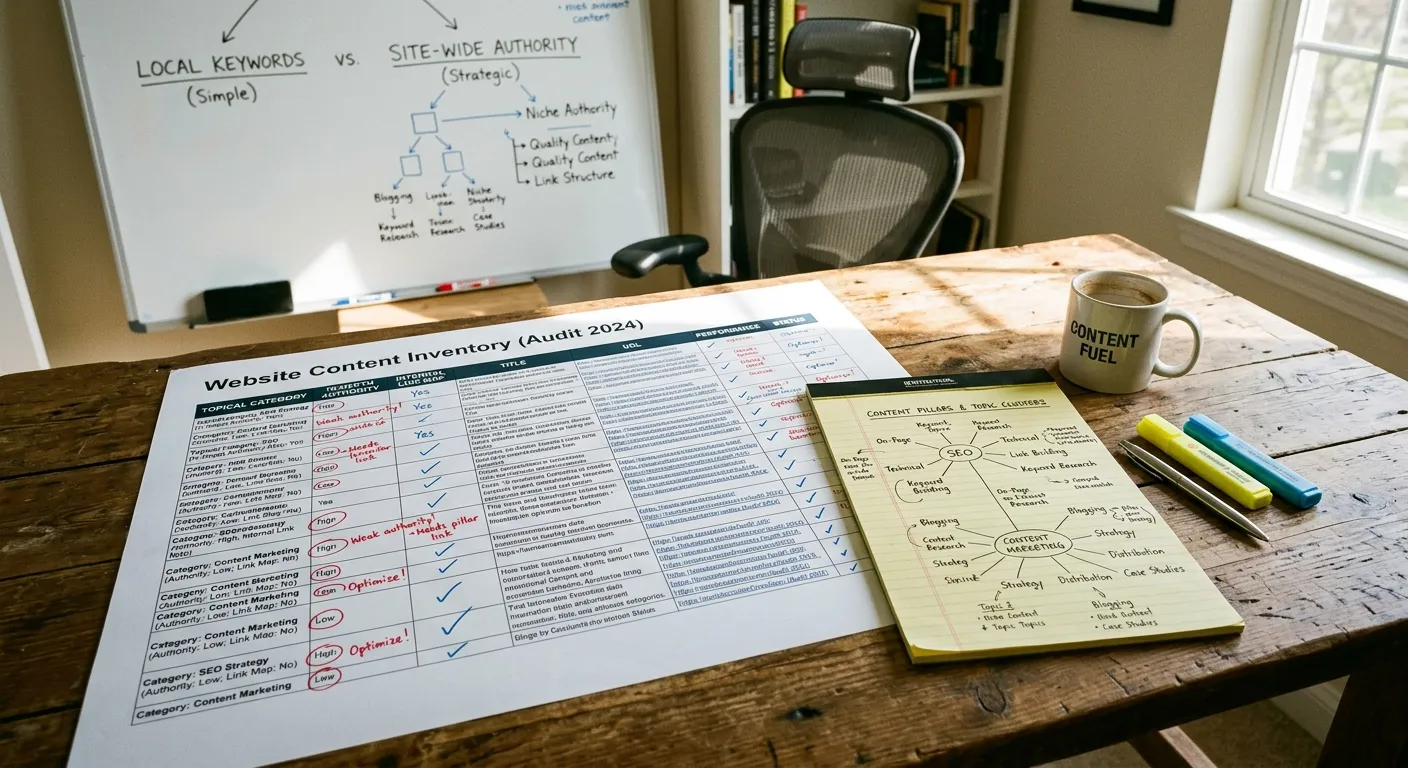
Documenting real operational data and mechanical parameters on your website creates a technical barrier that out-of-state competitors cannot duplicate through simple search engine optimization.
Step 4: The Internal Network Mapping
The final step of the audit is analyzing how your pages connect. A common characteristic of local brochure websites is "orphaned pages"—service pages that exist in isolation without internal context or technical support. A true authority site behaves like a highly organized textbook, where advanced concepts reference foundational guides and specialized sub-services link back to main capabilities.
Examine your internal links. Your high-level service overview pages must be supported by detailed technical sub-pages, glossary terms, and real project proofs. If you are managing distributed development teams from a Detroit headquarters, your digital architecture must mimic your operational workflows. Every service page needs a direct pipeline to supporting evidence, calculators, and detailed reference articles.
Comparing Content Patterns: Local Brochure vs. Corporate Giant vs. Elite Local Authority
To help you visual where your website sits in this competitive landscape, review this structural comparison of content strategies. It highlights how different tiers of websites handle the exact same service offering.
| Content Attribute | Generic Local Brochure | Generic Corporate Challenger | Elite Local Authority |
|---|---|---|---|
| Technical Detail | Low; uses general marketing statements. | Medium; contains high-level textbook definitions. | High; features specific machine names, tolerances, and mechanical standards. |
| Visual Assets | Generic stock photography of clean construction zones. | High-production, non-specific corporate imagery. | Raw, high-resolution on-site photos, design diagrams, and project logs. |
| Project Proof | A list of company names with no context or case history. | Polished case studies focusing on broad business metrics. | Granular project breakdowns with specific operational stats and local regulations. |
How to Rebuild Your Website's Content Infrastructure
If your audit reveals that your website is functionally a generic brochure, you must act. Rebuilding your site's content authority is not an overnight task, but you can secure quick victories by focusing on high-impact technical updates. Use the following implementation plan to begin your digital defense.
- Interview your technical team: Sit down with your lead estimator, head machinist, or logistics manager. Ask them to explain how they solve a complex problem for a customer. Record the conversation and transcribe it. This raw, unedited conversation is packed with authentic technical details that copywriters cannot invent. Use this transcript as the foundation for your service page updates.
- Build a technical resource library: Create a dedicated section of your website to host detailed reference guides. This should include material compatibility charts, calculation tools, regional compliance checklists, and schematic diagrams. By providing real, self-service utility, you transform your website from a simple sales pitch into an indispensable industry asset.
- Document your equipment assets: Publish a comprehensive list of your fleet, machinery, and software systems. If you run specific laser cutters, commercial trucks, or warehousing systems, list their exact model numbers, processing capacities, and dimensions. This transparency serves as an undeniable physical validation of your operational capacity.
- Implement structural data schema: Ensure your technical content is correctly annotated with structured schema markup. This code helps search engines easily identify product specifications, localized service areas, and organizational credentials, ensuring your deep authority signals are read clearly by modern indexing crawlers.
The transition from a simple local presence to an authoritative regional source requires a deliberate shift in perspective. You must stop viewing your website as a static utility and start treating it as a dynamic piece of operational infrastructure. When your digital presence matches your physical capabilities, out-of-state competitors will struggle to match your position in the market.
Frequently Asked Questions
How does content authority differ from standard local SEO keyword optimization?
Standard local SEO focuses heavily on regional keywords, schema markup, and citation consistency to rank in geographic map packs. Content authority, by contrast, evaluates whether your site demonstrates deep, technical industry expertise that can stand up to national giants. It is judged by the structural depth of your information, your proprietary documentation, and the concrete evidence of your practical experience.
How can a Detroit industrial firm compete with massive out-of-state corporate budgets?
Out-of-state corporate competitors rely on high-volume, generic content factories that rarely speak to granular, technical realities. A local firm wins by publishing hyper-specific project reports, precise engineering breakdowns, and raw regional regulatory knowledge that national writers cannot easily fake. By shifting your focus to high-fidelity, original research and direct project case studies, you establish absolute subject-matter dominance.
How often should we audit our website content for technical authority?
We recommend conducting a comprehensive content authority audit at least twice a year. This regular schedule allows you to identify thin content pieces, replace outdated industry statistics, and update old project logs with fresh performance telemetry. Continuous auditing prevents corporate competitors from identifying gaps in your content coverage and using them to slowly capture your local search footprint.
What are the most common signs that our website copy is too generic?
The most common signs are the heavy use of stock imagery, broad marketing definitions rather than technical specifications, and a total lack of concrete project metrics. If a competitor can copy your entire service page, swap out your company name, and have it read perfectly, your content lacks structural authority. True authority requires proprietary data, original schematic drawings, and direct proof of specialized execution.
Ready to build absolute digital authority?
From custom web systems to technical brand positioning, we design search strategies that ensure regional brands stand out and defeat national competitors.
Start a ProjectReady to put this into practice? Visit our custom web development page to see how we work.