
Updated November 10, 2026 · Editorial review by Iron Digital MI
Most business owners evaluate custom software with extreme caution—and rightly so. Standard off-the-shelf platforms promise instant setups and predictable monthly bills. However, as operations scale, rigid third-party tools force teams into cumbersome workarounds, double data entry, and manual steps that quietly leak payroll dollars every single week. When a company eventually considers commissioning custom internal portals or workflow engines, the initial engineering cost can trigger immediate pause.
The central question is never whether custom application development carries an upfront capital requirement. The real question is how quickly the operational yield recovers that capital. Evaluating software must rely on cold, mathematical reality: hours reclaimed, errors avoided, software subscriptions retired, and revenue protected set directly against build and running costs. Modeling these numbers gives owners a firm calendar month when their custom tool transitions from a capital expenditure into a permanent profit engine.
Key Takeaways
- Payback period equals initial build costs divided by net monthly operational yield (monthly savings minus cloud running fees).
- Four primary value drivers determine monthly yield: reclaimed labor hours, eliminated manual errors, retired SaaS licenses, and retained lead conversion.
- Well-scoped custom software projects routinely achieve full financial payback within 3 to 9 months of active operational deployment.
The Core Math Behind Software Payback
Calculating the return on custom application investment requires a clear financial formula. The payback period measures the exact number of months necessary for net operational returns to fully cover initial build costs. The core equation is simple:
Payback Period (Months) = Total Initial Capital Outlay / (Monthly Gross Yield - Monthly Running Costs)
To run this calculation accurately, every variable must be clearly defined:
- Total Initial Capital Outlay: The complete fixed cost to discover, scope, design, code, test, and launch the tool, along with staff onboarding.
- Monthly Gross Yield: The combined financial value generated every 30 days through reclaimed wages, material savings, higher proposal win rates, and canceled third-party software licenses.
- Monthly Running Costs: Ongoing operational overhead required to keep the app running, including cloud hosting, database scaling, API costs, and developer support retainers.
If a business invests $18,000 in a custom workflow app and generates $3,200 in monthly labor and subscription savings while paying $450 in hosting and retainer support, the net monthly yield is $2,750. Dividing $18,000 by $2,750 yields a payback period of 6.5 months. By month seven, the software generates pure financial gain.
Measuring the Four Value Drivers
To establish a trustworthy monthly yield, business leaders must quantify four distinct operational operational categories:
1. Reclaimed Payroll Hours
Administrative overhead represents one of the largest controllable expenses in any operating budget. When skilled employees spend hours manually re-keying paper forms into accounting software or copying field reports between web apps, payroll budget is spent on clerical maintenance rather than core business output.
Automation can save small business owners an average of 10+ hours per week on repetitive administrative tasks (Source: various SMB software industry surveys, 2023).
For an employee earning a fully loaded rate of $35 per hour (wages, taxes, and benefits), recovering 10 administrative hours per week returns $1,516 per month per staff member. On a team of four office employees, that represents over $6,000 in monthly capacity returned to direct customer service, estimating, or revenue-producing work.
2. Elimination of Costly Manual Errors
Manual data transcription carries an inherent human error factor. In service industries, transposed addresses or missing line items lead to missed service windows and disputed billing. In manufacturing, a wrong dimension entered into a spreadsheet leads to scrapped raw materials and lost machine hours. Quantifying this value driver requires examining historical customer credits, expedited shipping expenses, and scrap logs over the past 12 months to determine the average monthly price of operational mistakes.
3. Subscription and License Consolidation
Growing companies often fall into software sprawl. Over time, businesses stack multiple single-purpose cloud tools: a forms service ($80/month), a digital signature platform ($150/month), a specialized scheduling tool ($400/month), and custom add-on reporting modules ($250/month). Custom platforms allow companies to replace these disparate subscriptions with one unified dashboard built around their exact workflow, immediately cutting recurring software overhead.
4. Revenue Protection and Fast Customer Response
Sluggish response times harm sales conversion rates. When prospective clients wait several days for an accurate quote because field teams must bring paper receipts back to the main office, competitors win the work. Digital systems secure prospective deals by removing friction from customer touchpoints.
88% of online consumers are less likely to return to a site after a bad experience (Source: research cited by Amazon Web Services, 2019).
Providing instant customer portals, quick turnaround estimates, and clear project tracking directly protects customer retention and boosts proposal conversion.
Realistic Build and Running Costs
An accurate ROI formula depends on precise cost figures. At Iron Digital, custom applications, client portals, and business automation systems are quoted at a fixed price after the operational scope is fully defined, running $7,997 to $24,997+ depending on technical scope. Managed website support starts at $199/month, while ongoing optimization and development support run on our growth retainer at $799/month.
In addition to software build prices, running expenses must be factored into monthly ROI calculations:
- Database and Cloud Infrastructure: Cloud hosting on platforms like AWS or DigitalOcean typically ranges from $40 to $250/month based on database size and user access.
- Third-Party API Integrations: External transactional services (SMS notifications, mapping, or payment processing) generally range from $20 to $150/month.
- Continuous Maintenance: Allocating budget for routine updates, security patches, and minor UI adjustments keeps systems operating reliably long term.
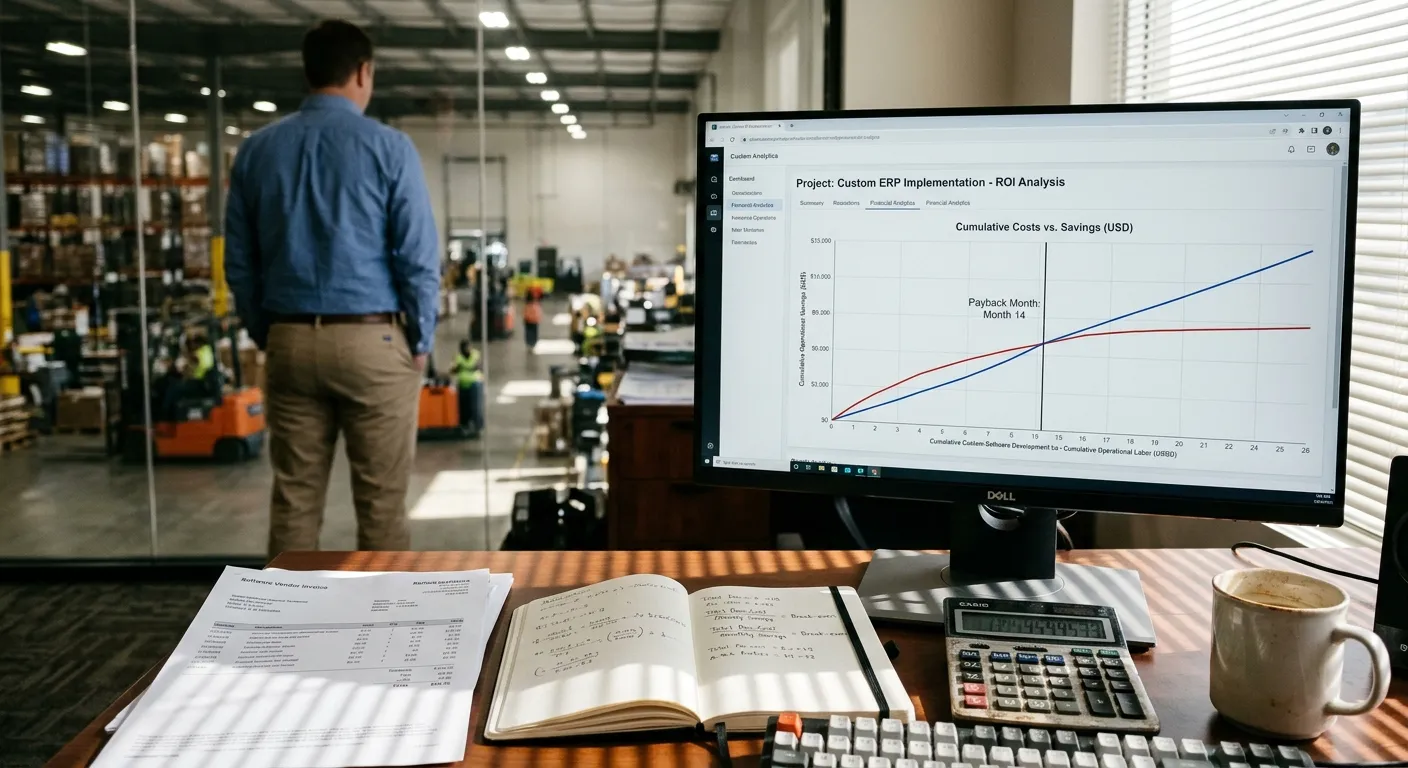
Building a tailored database schema and workflow automation replaces fragmented spreadsheets with unified real-time operational data.
Worked Example #1: Metro Detroit Field Service Business
Consider a hypothetical commercial mechanical and HVAC service company operating 14 field service vans across Southeast Michigan, supported by three full-time office dispatchers.
The Operational Friction
Field technicians used paper job tickets, recorded part numbers by hand, and handed paper files to the office every Friday afternoon. Office staff spent 18 hours every Monday re-entering job notes, cross-referencing parts inventories, and generating QuickBooks invoices. Invoices were delayed by an average of eight days post-job completion, and unbilled parts errors occurred on roughly 4% of work orders.
The Custom Tool and Investment
The company commissioned a tailored mobile field app and web dispatch portal. Field technicians log parts, document equipment specs, capture photos, and collect customer sign-offs on a tablet, immediately updating central database records.
- Scope: Mobile technician app, dispatcher web dashboard, and automated invoice staging integration.
- Initial Fixed Build Cost: $18,500 (hypothetical example).
- Monthly Infrastructure & API Fees: $160/month.
- Ongoing Support Retainer: $799/month.
- Total Monthly Running Cost: $959/month.
The Calculated Financial Yield
- Labor Reclaimed: Office dispatchers saved 50 collective hours per week in manual entry. At a loaded rate of $30/hour, this saved $6,500 per month. Technicians saved 1.5 hours per week each on administrative paperwork, gaining 21 hours per week of total billable field availability ($3,150/month in expanded capacity).
- Error Elimination: Unbilled parts dropped from 4% to under 0.3%, recovering $1,200 per month in previously lost material costs.
- Subscriptions Retired: Canceled two standalone mobile form and dispatch SaaS accounts, saving $580/month.
The Payback Calculation
Total Monthly Gross Yield = $6,500 (dispatch labor) + $1,200 (error recovery) + $580 (SaaS retired) = $8,280/month.
Net Monthly Yield = $8,280 - $959 (running costs) = $7,321/month.
Payback Period = $18,500 / $7,321 = 2.52 months.
By the third month, the platform fully paid for itself, generating over $87,000 in annual net operational value. For growing service organizations operating multiple service regions, maintaining central oversight becomes vital, as explored in our guide on managing distributed development teams from a Detroit headquarters.
Worked Example #2: Precision Manufacturing Shop
Consider a hypothetical precision machining shop in Warren, Michigan, with 24 employees producing custom metal components for industrial clients.
The Operational Friction
Order status was tracked using printed traveler sheets attached to shop bins. Machine operators recorded setup times and scrap rates manually. Estimators took 3 to 4 days to return custom quotes because historical tooling data and current machine capacity were stored across separate desktop spreadsheets.
The Custom Tool and Investment
The facility built a digital job tracking portal and fast estimation dashboard installed on shop floor tablets at each work cell.
- Scope: Shop floor traveler tracking, digital setup logging, and instant quote calculation tool.
- Initial Fixed Build Cost: $22,000 (hypothetical example).
- Monthly Infrastructure Costs: $210/month.
- Ongoing Maintenance Retainer: $799/month.
- Total Monthly Running Cost: $1,009/month.
The Calculated Financial Yield
- Scrap & Rework Savings: Standardized setup checklists and real-time tolerance tracking reduced setup scrap by 14%, saving $2,800 per month in raw material waste and lost machine cycles.
- Improved Bid Win Rates: Reducing quote turnaround from 4 days to 3 hours increased bid win rate by 5%, securing an estimated $3,800 per month in additional profit margin.
- Labor Reclaimed: Plant managers saved 12 hours weekly on manual job status tracking, reclaiming $2,100 per month in high-value engineering time.
- Subscriptions Retired: Replaced legacy reporting software, saving $340/month.
The Payback Calculation
Total Monthly Gross Yield = $2,800 (scrap) + $3,800 (bid wins) + $2,100 (manager labor) + $340 (SaaS retired) = $9,040/month.
Net Monthly Yield = $9,040 - $1,009 (running costs) = $8,031/month.
Payback Period = $22,000 / $8,031 = 2.74 months.
In less than 90 days, the shop fully recouped its build investment. As regional manufacturing districts modernize across Macomb, Wayne, and Oakland counties—a shift highlighted in our article on how Detroit's neighborhoods are the next digital frontier—tailored tools provide a distinct competitive advantage over legacy operations.
Comparing Financial ROI Across Industries
The table below summarizes the key financial drivers and return timelines for both case studies:
| Financial Metric | Field Service Business | Small Manufacturer |
|---|---|---|
| Initial Capital Outlay | $18,500 (hypothetical) | $22,000 (hypothetical) |
| Primary Value Source | Office labor & invoice speed | Scrap reduction & fast quotes |
| Monthly Running Expenses | $959 / month | $1,009 / month |
| Net Monthly Operational Gain | $7,321 / month | $8,031 / month |
| Estimated Payback Period | 2.5 Months | 2.7 Months |
| 3-Year Net Yield | $245,056 | $267,116 |
When Custom Software Is NOT the Right Decision
Custom application development is an operational multiplier, not a universal replacement for all commercial tools. Commissioning software is rarely advised under the following circumstances:
- Off-the-Shelf Tools Address 90%+ of Needs: If standardized platforms fit your operational steps cleanly without forcing duplicate work, commercial SaaS is almost always the more cost-effective path.
- Processes Are Unstable or Changing Rapidly: Automating chaotic workflows simply accelerates inefficiency. Define and test manual workflows thoroughly before writing code.
- Lack of Internal Adoption Ownership: Software yields value only when embraced by staff. Without committed management leadership enforcing adoption, software investments fail to deliver returns.
Frequently Asked Questions
How long does custom business software take to build and launch?
Most targeted workflow apps, internal portals, and automation systems are scoped, coded, and deployed in 6 to 12 weeks. Staged releases allow teams to start using primary features and reclaiming hours early in the build timeline.
What ongoing software running expenses should I plan for post-launch?
Standard running costs consist of database hosting ($40–$250/month) and third-party transactional service fees ($20–$150/month). Optional managed retainer support, like Iron Digital's $799/month growth retainer, provides active system optimization and feature updates.
How do I know if my operational problem warrants custom software over commercial SaaS?
If your staff spends more than 10 hours per week re-keying data between multiple platforms, or if commercial software forces workarounds that harm customer response times, custom software typically pays for itself quickly.
How is pricing calculated for custom software projects at Iron Digital?
Iron Digital quotes custom applications and portals at a clear fixed price after scoping your operational workflows. Typical build scopes range from $7,997 to $24,997+ depending on user roles, integrations, and technical requirements.
Plan the next improvement.
Tell us what your operational team needs to accomplish and where current systems cause daily friction.
Start a Project