
Updated September 23, 2026 · Editorial review by Iron Digital MI
← Back to BlogLocal search optimization has a dirty open secret. Dozens of software companies still pitch "reputation protection" or "review management" funnels that do one specific, prohibited thing: they filter out unhappy clients. The sales pitch sounds like common sense. If a customer clicks four or five stars, the system routes them straight to your Google Business Profile. If they click three stars or fewer, they get a polite, private feedback form that keeps their complaint out of the public eye.
This tactic is called review gating, and it violates Google's core terms of service. For a long time, business owners treated Google's guidelines as minor suggestions rather than hard rules. That calculation is now backfiring. Google's algorithms have evolved, and the penalties for filtering feedback are swift, highly destructive, and remarkably difficult to reverse.
Key Takeaways
- Gating is a direct violation: Filtering customers based on sentiment before sending them to Google completely violates Google's Maps Contributed Content Policy.
- The penalties are catastrophic: Violations lead to the wholesale deletion of all reviews, profile suspension, or permanent brand warnings on Google Maps.
- Automation must remain neutral: Compliant campaigns ask every customer for feedback, giving everyone equal, uninhibited access to write public reviews.
What Actually Counts as Review Gating?
Many local businesses engage in review gating without realizing they are crossing a line. They believe that because they use a popular third-party software provider, the system must be compliant. In reality, SaaS companies often sell outdated methods because they know small business owners are terrified of a negative rating.
To understand the boundary, look at the architecture of your feedback collection. Review gating is any system that forces users through a pre-evaluation filter to determine whether they receive a link to your public profiles. If you send an email asking "How did we do?" and the interface branches into two separate functional results based on the response, you are gating.
Consider a standard service company operating in downtown Detroit's active business market. If they use a feedback funnel that only displays the Google icon to clients who select "Excellent," while sending "Fair" or "Poor" clients to a contact form, they are actively manipulating their public profile score. Google's explicit stance is that all customers must have the same opportunity to write a review, regardless of whether their feedback is positive, negative, or neutral.
The Mechanics of a Policy Violation
Google's Maps Contributed Content Policy contains clear, non-negotiable guidelines on conflict of interest and review solicitation. The document states: "Don’t discourage or prohibit negative reviews or selectively solicit positive reviews from customers."
This means your request workflow must be completely linear. To illustrate the difference between compliant systems and those that invite swift penalties, review the operational pathways outlined in the comparison table below.
| Step in the Funnel | Gated (Violates Terms) | Compliant (Safe & Approved) |
|---|---|---|
| Initial Solicitation | Asks the customer to rate their experience from 1 to 5 stars inside an email template. | Asks the customer to share their experience on Google via a direct, unfiltered link. |
| The User's Choice | Clicking 1-3 stars triggers an internal form; 4-5 stars redirects to Google Maps. | Every user receives the same options to leave a public review, regardless of their sentiment. |
| Data Collection | Negative feedback is actively hidden in private databases to protect the brand score. | Private feedback is optional and collected alongside a public review link, never instead of it. |
The Penalties: What Happens When You Get Caught
Historically, Google was slow to police these practices. If you ran a gated campaign in 2021, you likely got away with it. Today, the enforcement mechanism is heavily automated. Google utilizes advanced text-analysis algorithms and traffic pattern indicators to detect sentiment-selective review acquisition. If your business is flagged, the consequences are immediate and severe.
The most common penalty is the absolute deletion of your entire review database. Google does not take the time to separate gated reviews from legitimate, organically earned feedback. They simply wipe the slate clean, dropping a highly-rated profile with hundreds of reviews down to zero. In more severe instances, Google suspends the Google Business Profile entirely, stripping the business of its rankings in the local map pack.
Furthermore, Google has begun testing public warnings on suspicious profiles. These warnings inform users that the business has been flagged for review manipulation. For any brand, having a giant warning banner placed directly over your map listing is far more damaging than a handful of honest 2-star reviews.
Why Software Companies Still Sell Gated Funnels
If the rules are this clear, why are reputation management platforms still marketing review gating as a feature? The answer is simple: client retention. SaaS companies know that business owners hate seeing negative reviews. Providing a tool that promises to intercept unhappy customers helps sell software, even if it places the client's long-term digital health at massive risk.
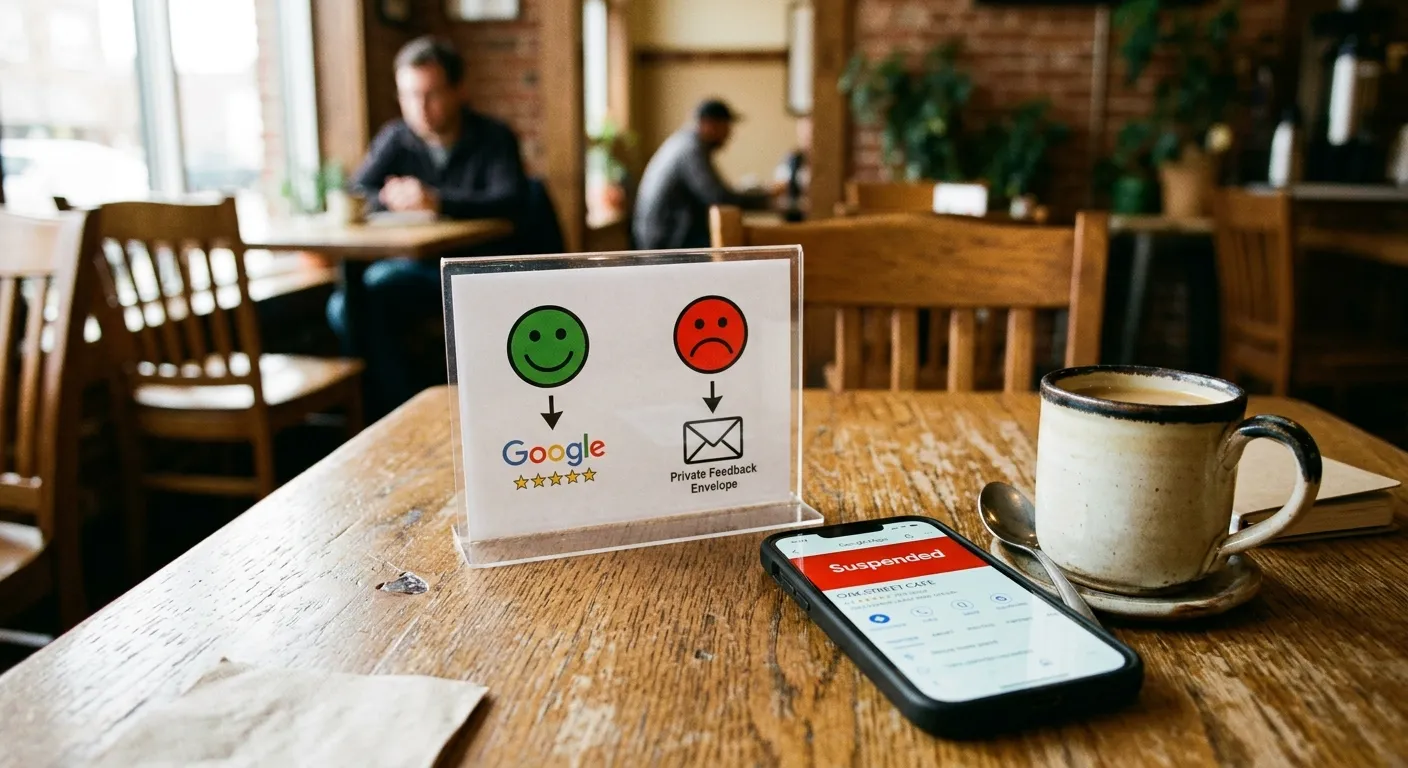
Building a clean, compliant review collection process ensures your Google Business Profile remains secure against sudden algorithmic sweeps.
These platforms often try to bypass detection by using custom redirects or landing pages that alter their styling based on cookies. However, Google's crawling systems are highly capable of detecting conditional redirects. The moment Google's bot discovers that a landing page presents different options based on prior user behavior, the entire domain and its linked profiles are flagged. Relying on software tricks to hide review manipulation is a losing battle against an engineering team with infinite resources.
Compliant Ways to Earn More Google Reviews
Instead of trying to trick the system, focus on reducing friction in your compliant funnels. Use these methods to scale your feedback safely:
- Ask directly and consistently: Embed clean, direct links to your Google Business Profile in post-purchase communications, digital invoices, and email signatures. Do not ask for a rating first; simply invite them to share their honest feedback.
- Use physical and digital print: For field service businesses, include a high-contrast QR code on your printed invoices or service slips. Hand it to the client and ask them directly before leaving the premises.
- Train your staff to request feedback: The best review collection tool is a human connection. If your team delivers great service, train them to say: "If you're happy with my work today, leaving a quick review on Google really helps me out."
How to Handle Negative Feedback Professionally
The fear of negative reviews is what drives business owners to gate their funnels in the first place. This fear is largely misplaced. A profile with a flawless 5.0 rating and hundreds of entries often looks suspicious to modern buyers. A smattering of lower ratings shows that your business is real, human, and operating in the physical world.
When you receive a negative review, do not panic. Use it as an opportunity to demonstrate your customer service publicly. Respond quickly, stay strictly professional, and avoid getting defensive. Offer a direct way to take the conversation offline, such as a phone number or support email address. When prospective clients see a business owner handling criticism with professionalism and speed, they often overlook the complaint entirely.
If your team is managing a highly active service schedule in Detroit's expanding neighborhoods, building a transparent feedback system is the only way to scale securely. Steer clear of the manipulative shortcuts sold by legacy reputation platforms, build your own compliant collection systems, and let your actual service quality speak for itself.
Frequently Asked Questions
What exactly happens if Google catches my business gating reviews?
Google can take several severe actions. They may delete your entire history of reviews, temporarily suspend your Google Business Profile, or permanently ban the listing from search results. Recently, Google has also started testing public warning badges on listings suspected of review manipulation.
How does Google know if I am filtering out bad reviews?
Google’s published policy prohibits selectively soliciting positive reviews and discouraging negative ones. Follow that policy without claiming to know the undisclosed detection process or promising a specific enforcement outcome.
Is it illegal to ask a customer to change a bad review?
No, it is legal to reach out to an unhappy customer to resolve their complaint. Once their issue is fully resolved, you may politely ask them if they would consider updating their public review to reflect their current experience. However, offering financial incentives, discounts, or free services in exchange for changing a review is against Google's policies and FTC rules.
Can I still ask customers for feedback before sending them a review link?
Yes, you can ask for private feedback. However, to remain compliant, you must present the Google review link clearly to everyone, regardless of their feedback rating. You cannot design a digital path that blocks, hides, or discourages the public review button for users who indicate they had a negative experience.
Looking to build a highly compliant, custom local marketing system?
From modern, lightning-fast web design to optimized conversion funnels, we construct clean digital systems that help your brand stand out safely.
Start a ProjectReady to scale your local presence? Visit our custom web design template gallery to see how we build.