Updated November 3, 2026 · Operational Analysis by Iron Digital MI
If you manage an HVAC, plumbing, electrical, or field service business with two to ten technicians in Southeast Michigan, your dispatcher’s morning is usually organized chaos. Phone calls start hitting at 6:30 AM. A commercial rooftop compressor fails in Warren, a homeowner in Royal Oak has a flooded basement, and your senior master electrician is stuck in gridlock on I-696 near Southfield.
How you route those calls and manage crew status determines whether you clear six billable jobs per tech today or cap out at three while paying overtime. For years, service business owners had two options: messy whiteboards paired with text messages, or massive enterprise software platforms designed for 200-van fleets across five states. Today, the market is flooded with off-the-shelf field service management (FSM) apps charging anywhere from $49 to $180 per seat every single month. But for small, tight-knit Michigan trade teams, these tools often create as much friction as they solve.
Key Takeaways
- Off-the-shelf subscription apps work well for standard residential calls, but per-seat pricing scaling up to $1,500+ monthly quickly becomes an operational drag for 5 to 10 tech teams.
- Generic software often fails on specialized local workflows like multi-county supply house staging, winter weather emergency rerouting, and custom contractor pay formulas.
- Building a targeted internal dispatch tool turns software from a recurring liability into a fixed-asset system tailored directly to how your dispatchers and technicians operate daily.
The Off-the-Shelf Dispatch Promise (and the Per-Seat Math)
Subscription software options like ServiceTitan, Housecall Pro, and Jobber sell convenience. You sign up with a credit card, download an iOS or Android app onto your techs' phones, and start dragging calendar blocks across a grid. For a solo operator running one van, paying $49 a month is an absolute no-brainer.
However, once your service team expands to five trucks, an office dispatcher, a parts manager, and two apprentices, the SaaS pricing curve turns steep. Most platforms gate key operational capabilities—like automated customer SMS notifications, inventory tracking, or multi-location dispatching—behind high-tier plans. Suddenly, you are paying $120 to $180 per active user account every 30 days.
Do the straightforward arithmetic for an eight-person trade team:
- 8 Field Techs + 2 Office Staff = 10 Active Seats
- 10 Seats × $149 average monthly subscription tier = $1,490 per month
- Annual Recurring Software Expense = $17,880 every year
Over three years, you spend more than $53,000 renting software that you never own. Every time you hire a seasonal helper or expand your crew to handle winter freeze emergencies across Wayne and Oakland counties, your monthly software tax goes up immediately.
Where Subscription Software Breaks for Michigan Trades
The financial cost is only half the equation. The operational mismatch is where trade businesses experience real friction. Commercial and specialized residential service in Southeast Michigan relies on operational habits that standard subscription software rarely accommodates out of the box.
Consider how local trade work actually flows on a typical Tuesday morning:
1. Multi-County Supply Pickup and Staging: A commercial plumbing contractor based in Livonia might send a tech from a job in Canton to pick up specific cast iron fittings at a supply house in Detroit before heading to a long-term site in Sterling Heights. Generic dispatch tools treat every job as a straight A-to-B driving line. They lack built-in logic for staging material runs, tracking supplier order numbers alongside job records, or assigning pickup legs to floating apprentices.
2. Complex Subcontractor and Union Pay Rules: Many local mechanical and electrical contractors combine W-2 service technicians with specialized 1099 subcontractors during peak seasonal surges. Standard FSM tools charge full per-seat rates for temporary subs while forcing all workers into uniform pay and job-status templates that do not reflect local piece-rate or union labor agreements.
3. Feature Bloat Overwhelming Field Technicians: Mass-market SaaS tools attempt to cater to every service trade simultaneously—from carpet cleaners to solar installers. As a result, field screens become cluttered with 40 mandatory input fields, upsell scripts, and complex survey forms. When a tech working in a cold crawl space in Macomb County has to tap through six nested menus just to mark a ticket as "Complete & Ready for Billing," they simply stop using the app. Office managers spend hours at the end of the week chasing down missing field notes manually.
Automation can save small business owners an average of 10+ hours per week on repetitive administrative tasks. (Source: various SMB software industry surveys, 2023)
When software requires 10 hours of manual data cleanup to overcome rigid system limitations, the software is no longer serving your business—your business is serving the software.
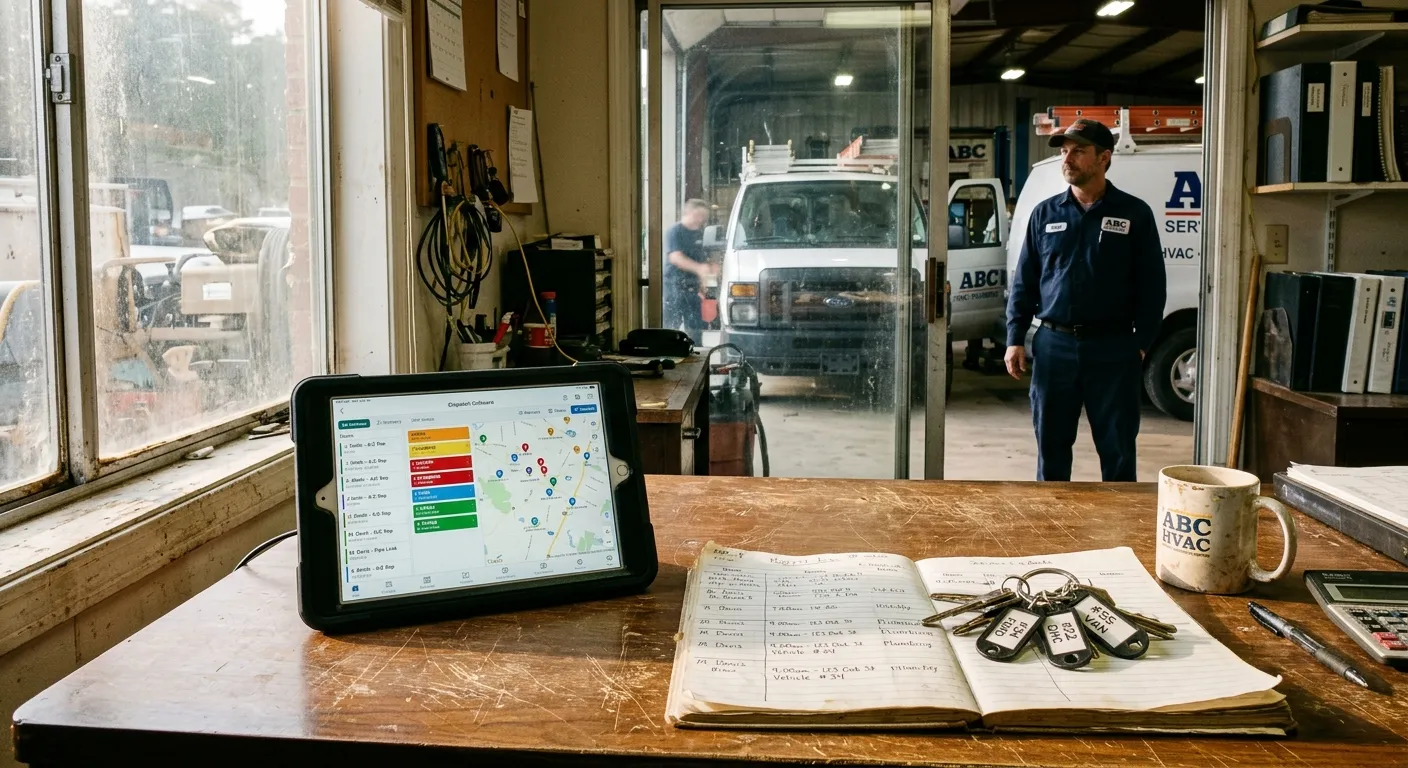
A purpose-built dispatch dashboard streamlines real-time route changes and job updates without complex per-seat license fees.
The Build Alternative: How Purpose-Built Software Changes Ops
Building targeted operational software does not mean reinventing Google Maps or writing a complete accounting package from scratch. Today, creating a custom dispatch application means assembling a lightweight, high-speed system focused exclusively on your company's actual workflow.
When you build a tailored system using clean database structures and dedicated web frontends—frequently integrated directly into your existing back-office systems via custom app development—you control the entire operational interface. Your field techs get a fast, responsive web interface that opens in three seconds, shows their exact route for the day, and lets them complete jobs with two taps.
Here is what changes when a 2-to-10 person trade crew moves from a rented SaaS tool to an owned dispatch solution:
- Zero Per-Seat Fees: Whether you run 4 tech vans or 14, your software costs stay fixed. Seasonal helpers, subcontractors, and office assistants log in without increasing your monthly bills.
- Tailored Route & Status Logic: Dispatchers can view real-time job status categorized by your trade's actual stages (e.g., "En Route," "Material Staged," "Permit Pending," "Inspection Scheduled") rather than generic industry labels.
- Direct Integration with Client Portals and Web Systems: Job status updates, work order approvals, and customer notifications flow directly into your web presence. Connecting your dispatch system with your business automation workflows allows automatic SMS updates to homeowners when a technician leaves the previous job.
- Full Data Ownership: Your customer history, job records, equipment service logs, and pricing datasets belong entirely to you in a private database—never locked inside a proprietary SaaS platform that charges export fees if you decide to leave.
Comparing the Options: Renting vs. Building
To evaluate which path fits your current company size and growth goals, review how subscription SaaS compares to a custom-built dispatch tool across key business operational areas:
| Evaluation Factor | Off-the-Shelf SaaS | Custom Built Tool |
|---|---|---|
| Upfront Investment | $0 to $1,500 onboarding fee | Fixed project quote (typically $7,997 to $24,997+) |
| Monthly Operational Cost | $500 to $2,000+ per month indefinitely | Minimal server hosting ($30–$100/mo) |
| User License Limits | Strict per-seat charges for techs & office | Unlimited users, techs, and contractors |
| Workflow Flexibility | Rigid; must adapt company process to software | 100% matched to your exact company playbook |
| Tech Adoption Speed | Slower due to multi-screen menu navigation | Faster; minimal screens built for field usage |
| Long-Term Asset Value | Zero equity; access stops if subscription ends | Permanent digital business asset that builds value |
When Subscribing Still Makes Sense
Building software is an investment that requires clarity around your internal processes. Renting a commercial SaaS platform remains the logical choice under specific operational conditions:
- You Have Fewer Than Three Technicians: If you run a two-truck operation, paying $150 a month total is highly cost-effective. The total cash outlay remains low while you build baseline customer volume.
- Your Workflow is 100% Standardized Residential: If every job is a simple 45-minute call with identical diagnostic pricing and immediate credit card collection on-site, off-the-shelf templates handle the job fine.
- You Lack Defined Operating Procedures: Custom software automates and speeds up your operational playbook. If your company has not yet established clear rules for how job tickets are assigned, approved, and billed, off-the-shelf software can provide a temporary structure to follow.
When Building a Custom Dispatch Tool Pays Off
For trade contractors operating between two and ten service vehicles in Michigan, building a targeted dispatch application becomes financially compelling when one or more of these benchmarks hit:
Your Per-Seat SaaS Bills Exceed $8,000 Annually: At $700–$1,500 per month in subscription software fees, a custom app quoted at a fixed price between $7,997 and $24,997 pays for itself in 12 to 24 months. After break-even, those software savings go straight back into your cash flow or truck maintenance budget.
You Run Specialized Commercial or Institutional Work: If your team handles backflow preventer certifications, industrial refrigeration retrofits, or municipal electrical contracts requiring specialized photo documentation and custom customer PDF sign-offs, standard apps fall flat. Custom systems generate exact compliance paperwork automatically upon ticket closure.
You Want Field Techs Focused on Work, Not Data Entry: A custom application removes all non-essential fields. Technicians open their mobile browser, tap "Arrived," complete their checklist, upload job photos, tap "Complete," and move to the next customer call. No extraneous upsell pop-ups or confusing software updates get in their way.
The Strategic Path Forward for Trade Business Owners
Software should be an operational leverage engine for your trade business, not a permanent administrative expense that grows every time you add a technician to your roster. Before renewing another annual software contract or signing a long-term per-seat agreement, take a detailed look at your actual dispatch operations.
Document where your dispatcher spends time making manual adjustments, count how many screen taps your field techs perform per ticket, and calculate your total software spend over the next three years. If you find your business bending its operations to fit rigid subscription software, it may be time to own your tools rather than rent them.
Frequently Asked Questions
How long does it take to build a custom dispatch tool for a service crew?
A targeted dispatch tool for a 2-to-10 person trade crew is typically scoped, built, tested, and deployed within 6 to 10 weeks. Because the build focuses exclusively on your team's essential daily workflows, deployment happens quickly without months of downtime.
Will my field technicians need to download complex mobile apps?
No. Modern custom dispatch systems are built as fast, progressive web applications that run directly in any standard mobile browser on iOS or Android. Technicians simply bookmark the web link on their phones, allowing them to access schedules and close tickets instantly without app store updates.
How does custom dispatch software integrate with accounting programs like QuickBooks?
Custom applications connect directly to QuickBooks Online or desktop accounting systems using secure APIs. When a field technician completes a work order, customer details and line-item totals synchronize automatically with your invoicing queue without manual re-entry.
What happens to our software costs as our crew expands from 5 to 15 trucks?
Unlike subscription software that increases your bill per user seat, an owned custom tool maintains fixed operational costs regardless of team size. You can add new technicians, dispatchers, or seasonal contractors without paying additional license fees.
Ready to streamline your crew's dispatch ops?
Tell us how your service business runs and where commercial software gets in your way. We will help you scope a fast, practical solution built specifically for your team.
Start a Project