Updated September 23, 2026 · Editorial review by Iron Digital MI
← Back to BlogIf you run a local service business, a regional contracting firm, or a B2B agency in Metro Detroit, your digital market is fundamentally fragmented. You want high-intent leads from Detroit neighborhoods like Sherwood Forest or Corktown, but you also need to win business in Ferndale, Royal Oak, Warren, Southfield, and Troy. To capture this search volume, businesses have historically relied on a simple tactic: build a single city service page, duplicate it fifteen times, use find-and-replace to swap the municipal names, and publish.
Near-identical location pages may offer little additional value, and Google may choose one representative URL. Create separate pages when they answer distinct customer questions; do not assume every duplicate causes a sitewide penalty.
Key Takeaways
- Cloning a single landing page and swapping city names will trigger search engine filters, causing most of your local pages to be ignored entirely.
- True localization requires regionalizing project details, highlighting municipal-specific building codes, referencing local cross-streets, and addressing distinct suburban structural differences.
- Utilizing a hub-and-spoke content architecture allows you to concentrate search authority on a main page while capturing long-tail regional traffic on unique, high-value local pages.
What Genuinely Must Differ Between City Pages
True localization is not about rewriting every single sentence on every landing page from scratch. It is about understanding the distinct dynamics of the region. As we highlighted in our guide on how Detroit's neighborhoods are the next digital frontier, hyper-local targeting is no longer optional for businesses that want to dominate the metro area.
To build high-ranking, highly converting pages for both sides of 8 Mile, you must focus on the factors that naturally change between different municipalities. If you want Google to treat each page as an independent asset, you must make these structural distinctions clear:
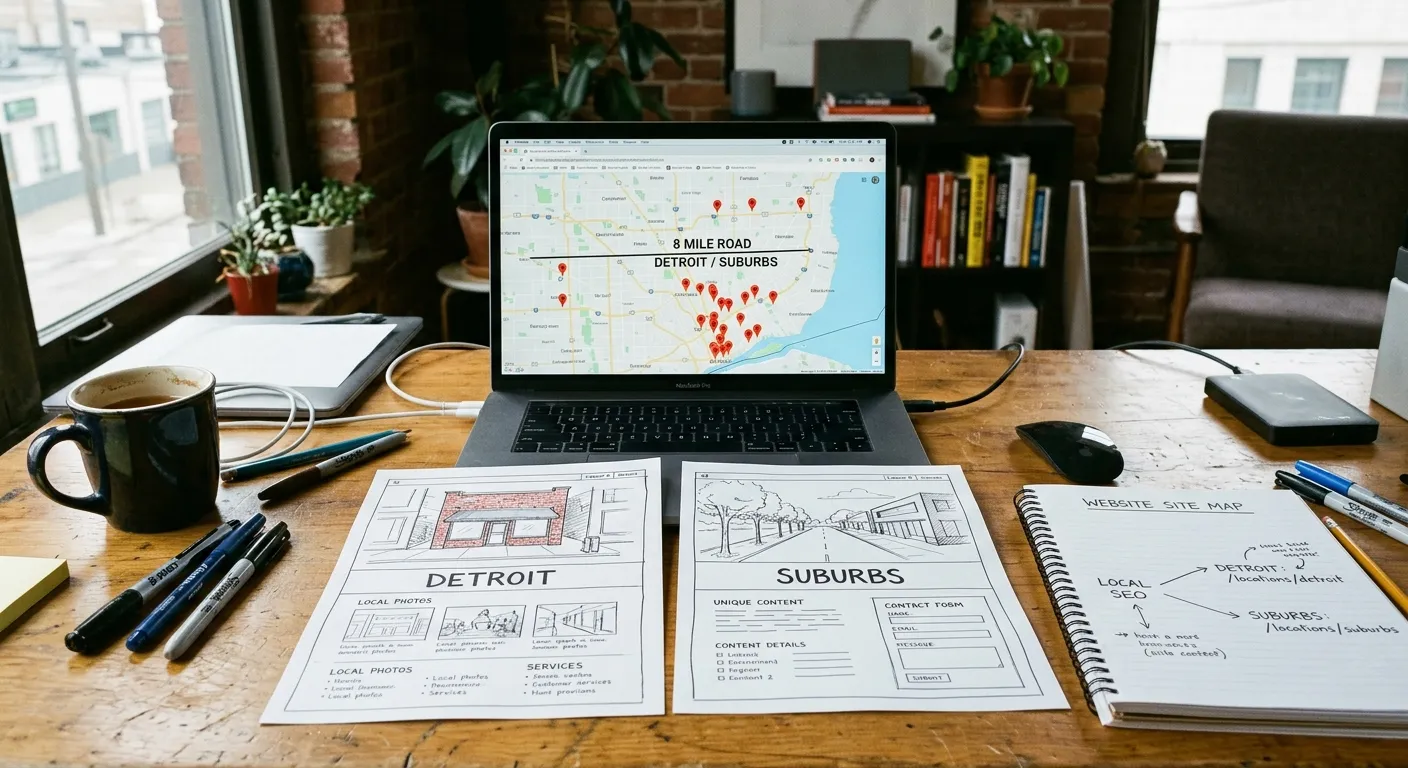
Building high-ranking local landing pages requires structuring unique content based on regional housing stock, municipal codes, and local landmarks.
1. Housing Stock and Commercial Infrastructure Differences
The physical problems your customers face vary wildly across county lines. A home services company operating in Grosse Pointe will deal primarily with historic, plaster-walled residences built in the early 20th century. A company working in Macomb Township or Novi will deal with modern, drywall-heavy, large-footprint suburban developments. Your landing pages must address these actual physical differences. Mentioning historic preservation on your Grosse Pointe page and modern insulation standards on your Novi page naturally creates highly valuable, localized content that search engines love.
2. Municipal Code and Permitting Specifics
Every suburb has its own local bureaucracy, and your customers are often highly aware of it. If you are an electrical contractor, a page targeting Southfield should reference Oakland County building permit processes or Southfield inspectors. A page targeting Ann Arbor should focus on local green building initiatives. Highlighting these real-world business realities proves to both Google and prospective clients that you do real business in their specific community.
3. Real Project Galleries and Neighborhood References
Instead of relying on generic stock photography, display actual projects completed in that specific zone. If your team completed a commercial build-out in Troy, name the local business park or mention its proximity to Big Beaver Road. If you worked on a residential home in Ferndale, mention the historic Bungalow or Craftsman architecture characteristic of the area. This anchors your page in physical reality, creating an authentic user experience that separates you from national competitors using generic templates.
Comparing Local SEO Approaches
The differences between low-effort templating and real localized content are stark. While templated pages can be deployed quickly, they consistently fail to rank and convert in competitive metro markets where sophisticated local players are active.
| Performance Metric | Cloned Landing Pages | Fully Localized Pages |
|---|---|---|
| Indexation Rate | Extremely low. Google usually filters out 80% of duplicate pages. | Nearly 100%. Every page is treated as a unique, independent regional asset. |
| Conversion Rates | Weak. Savvy local users easily spot the generic find-and-replace text. | High. Visitors see local project references, local permit data, and local reviews. |
| Ranking Potential | Limited to extremely low-competition suburbs with zero local competitors. | Strong. Ranks for high-intent, long-tail localized searches. |
The Hub-and-Spoke Content Strategy
You do not need to spend hundreds of hours writing entirely unique 2,000-word essays for fifteen different suburbs to execute this successfully. Instead, implement a highly structured hub-and-spoke content engine. This model allows you to scale your local footprint while keeping your internal production overhead highly manageable.
Your Hub Page is your primary regional service directory (e.g., "Commercial Roofing Services in Southeast Michigan"). This page is highly comprehensive, covering your company's core methodology, specialized equipment, materials, licensing, safety protocols, and general warranty details. This page acts as the structural authority on your site.
Your Spoke Pages are your highly targeted local landing pages (e.g., "Flat Roof Repair in Warren," "Commercial Roofing in Southfield"). These pages do not repeat the basic descriptions of how commercial roofing works. Instead, they reference your core methodologies briefly and focus 100% of their unique copy on local execution:
- Specific project case studies detailing a flat roof installation in Warren, complete with local climate considerations.
- Suburban municipal permit links and compliance details specific to Macomb County building codes.
- Embedded client testimonials from business owners located directly in Warren.
- A direct link pointing back to the main Hub page for deep technical specifications, passing valuable search authority back to your core service pages.
The commercial boom in Southeast Michigan is not restricted to a single zone. While downtown Detroit's revitalization has captured national headlines, the surrounding suburbs represent highly profitable micro-markets that require custom search strategies. By structuring your site around a hub-and-spoke model, you avoid duplicating generic definitions and instead allow each regional page to focus strictly on hyper-local authority.
Actionable Playbook for Local Landing Pages
To implement this model effectively, your team needs a structured process. Avoid programmatic generators that spin out low-quality text. Instead, use your existing business data to build highly relevant, unique pages that satisfy search engine quality guidelines.
Suburban Page Technical Audit Checklist
- Custom Title Tags: Avoid templated formulas like "[Service] in [City]." Use natural variations like "Ferndale Electrical Upgrades: Upgrading Historic Home Panels."
- LocalBusiness Schema: Inject unique structured schema data for each regional landing page, referencing the specific coordinates, service area, and local phone numbers where appropriate.
- Unique Map Embeds: Embed a customized Google Map displaying your service area boundaries or recent regional project pins for that specific suburb.
- Contextual Internal Links: Link your spoke pages back to your main service hubs with descriptive anchor text, passing internal search equity naturally.
Sources for Real Local Nuance
- Your CRM Data: Look at your historical job dispatch reports. Find the neighborhoods in Royal Oak or Troy where your trucks are most active, and name those specific residential developments on your local pages.
- Municipal Portals: Spend fifteen minutes on municipal websites checking permit requirements for your industry. Reference these exact requirements to build massive local authority.
- Customer Reviews: Filter your Google Business Profile reviews by location. Embed a review from a Warren resident on your Warren page, and a review from a Birmingham resident on your Birmingham page.
- Local Industry News: Stay informed on suburban infrastructure developments or localized weather-related structural patterns to address active problems.
Building high-performing city pages across Metro Detroit is not about tricking an algorithm. It is about presenting a clean, highly structured, and genuinely useful digital infrastructure to your local audience. When you build pages that respect the distinct realities on both sides of 8 Mile, you build a digital asset that consistently ranks, earns user trust, and scales your business long-term.
Frequently Asked Questions
Can I just use AI to rewrite my city pages fifteen times?
While generative AI can assist with drafting, simply asking an AI to spin fifteen identical pages will still lead to repetitive, low-value content. Google's helpful content algorithms easily identify low-effort programmatic rewrites that offer no real local insights or value.
How many city pages should my metro Detroit business actually have?
Focus on your top 5 to 10 most profitable suburbs first rather than trying to build pages for all 40+ municipalities in the metro area. Quality and unique authority on a few targeted pages will yield significantly better search rankings than thin, low-quality pages for every single zip code.
Do I need a physical office in a suburb to rank there?
No, you do not need a physical storefront to rank organically in adjacent suburbs, provided your local landing pages are unique, authoritative, and helpful. However, for Google Map Pack rankings, a physical location verified by a Google Business Profile is generally required.
Building a Detroit tech company and need the digital infrastructure to back it?
From your web presence to your back-end systems, we build what Detroit businesses need to compete at the level the market is moving toward.
Start a ProjectReady to put this into practice? Visit our custom web development page to see how we work.