
Updated November 10, 2026 · Editorial review by Iron Digital MI
When a client reserves a three-hour window for a $300 ceramic paint detailing session, a $150 medical spa consultation, or a $500 studio photo shoot and fails to show up, the loss is immediate and double-sided. You forfeit the direct revenue from that open time slot, and you turn away paying clients who could have taken that place on your schedule. Across local service operators in Metro Detroit, unconfirmed appointments without financial skin in the game suffer from average no-show rates between 15% and 20%.
Despite this drain on earnings, independent business owners frequently resist instituting upfront booking deposits. The reservation is understandable: if you ask for credit card payment upfront during scheduling, will prospective clients back out of checkout and move to a competitor who books for free? The answer hinges entirely on user experience and messaging clarity. Requiring cash upfront without establishing operational trust or offering instant, single-touch payment choices creates high abandonment. However, when integrated properly, deposit systems filter out non-committal browsers while elevating the perceived prestige and professionalism of your company.
Key Takeaways
- Deposits cut chronic no-shows while protecting daily revenues, provided the checkout frames the fee as a balance credit rather than a penalty.
- Single-touch mobile wallet options like Apple Pay and Google Pay eliminate checkout drop-off by removing manual card entry on smartphones.
- Transparent cancellation windows and straightforward rescheduling terms eliminate buyer hesitation far better than rigid non-refundable disclosures.
The Psychology of Upfront Financial Commitment
When a prospective client books an appointment online, they form an impression of your business within fractions of a second. According to Stanford Web Credibility Research (2002), 75% of users admit to judging a company's credibility based on its website design. If your booking system appears outdated, cluttered, or visually unprofessional, requesting credit card details introduces instant skepticism. Research cited by Amazon Web Services in 2019 confirmed that 88% of online consumers are less likely to return to a site after a bad experience. Asking for money inside an unpolished user experience amplifies that drop-off.
When buyers perceive your operation as an established, premium service, paying a deposit feels completely normal. Consumers routinely submit advance payments for concert tickets, hotel rooms, airline flights, and medical procedures without hesitation. The primary hurdle in appointment checkouts is rarely the payment obligation itself—it is the excessive friction and lack of clarity during the process.
If your reservation screen demands fourteen required form fields, forces mandatory account registration, and requires full upfront payment through a multi-step form, clients step away. Conversely, if your checkout loads instantly, supports digital wallet autofill, and explicitly states that the deposit applies directly to the final invoice balance, clients complete the transaction with absolute assurance.
Determining Deposit Amounts: Comparing Pricing Models
Choosing the appropriate deposit threshold requires balancing buyer commitment with conversion volume. Asking for a token $5 fee on a $400 service fails to deter no-shows because the client has virtually no financial stake in turning up. On the flip side, demanding 100% pre-payment upfront creates unnecessary hesitation for first-time customers who have not yet evaluated your physical facility or staff.
Evaluating standard deposit frameworks helps identify the optimal structure for your specific operational model:
| Deposit Model | Typical Amount | Best Used For | Conversion Impact |
|---|---|---|---|
| Flat Fee Deposit | $25 – $50 flat rate | Salons, barbers, routine auto detailing, bodywork | Highest conversion rate; lowest customer hesitation |
| Percentage Deposit | 20% – 50% of total job | High-ticket jobs ($300+), medical spas, photo shoots | Balanced commitment for high-ticket service packages |
| Card Fee Authorization | $0 upfront ($50 penalty if missed) | High-volume medical practices, established clinics | Maximum checkout volume; requires post-miss charge tracking |
| Full Pre-Payment | 100% of service charge | Group workshops, seasonal events, limited pop-ups | Filters casual buyers completely; lowers total booking volume |
Selecting the right framework comes down to your typical invoice amount and scheduling flexibility:
- Flat Fee Structure ($25 to $50): Ideal when final pricing varies depending on physical inspection or add-ons. For a $100 hair styling appointment or an $80 maintenance wash, a $25 deposit guarantees schedule commitment without bogging the client down in complex percentage calculations during checkout.
- Percentage Deposit (20% to 50%): Essential for high-ticket jobs exceeding $300, such as full-vehicle ceramic paint protection, multi-hour commercial photography sessions, or advanced medical aesthetic procedures. A 25% deposit on an $800 paint correction package ($200) ensures the client values the reserved time while keeping the remaining $600 deferred until the completed work is delivered.
- Card on File Authorization: Rather than processing an immediate card charge, your online system securely holds card details and explicitly informs the user that a late cancellation fee applies only if they cancel with less than 24 hours notice. This eliminates advance payment friction entirely while retaining legal enforcement against last-minute dropouts.
Drafting Cancellation Policies That Build Trust
Aggressive, combative legal warnings alienate prospective buyers faster than almost anything else. Statements like "ALL DEPOSITS ARE STRICTLY NON-REFUNDABLE UNDER ANY CIRCUMSTANCES" written in bold capital letters trigger defensiveness. Clients immediately question what happens if an emergency occurs, if illness strikes, or if weather delays their travel.
To preserve conversion rates, reframe your cancellation terms around rescheduling flexibility and fair operational notice:
"Your deposit directly reserves dedicated shop time and specialist labor. Need to adjust your time? Reschedule at least 24 hours in advance and your deposit transfers completely to your new time slot."
Reframing policy terms changes the customer's perspective from restrictive to supportive:
- Emphasize Financial Credit: Remind clients clearly: "Your $50 deposit is credited directly to your total balance upon arrival."
- Offer a Flexible Reschedule Safety Net: Provide a clean path for schedule adjustments: "Reschedule at least 24 hours prior to your slot, and receive a 100% balance transfer toward your rescheduled appointment."
- Provide Human Context: Explain the operational reality. Clients appreciate that an independent craftsman or small team cannot fill a sudden three-hour opening with ten minutes notice.
Eliminating Mobile Checkout Friction
According to Statcounter Global Stats (2024), mobile devices generate over 60% of global website traffic. If your client must manually key in a 16-digit credit card number, expiration month, CVV code, and billing zip code on a smartphone screen while multi-tasking, abandonment rates climb dramatically.
Checkout speed directly influences completed reservations. Research from Google and SOASTA (2017) demonstrated that 53% of mobile site visits are abandoned if a page takes longer than 3 seconds to load. Furthermore, Deloitte's 'Milliseconds Make Millions' report (2020) revealed that a 0.1 second improvement in mobile site speed increased retail conversion rates by 8.4%.
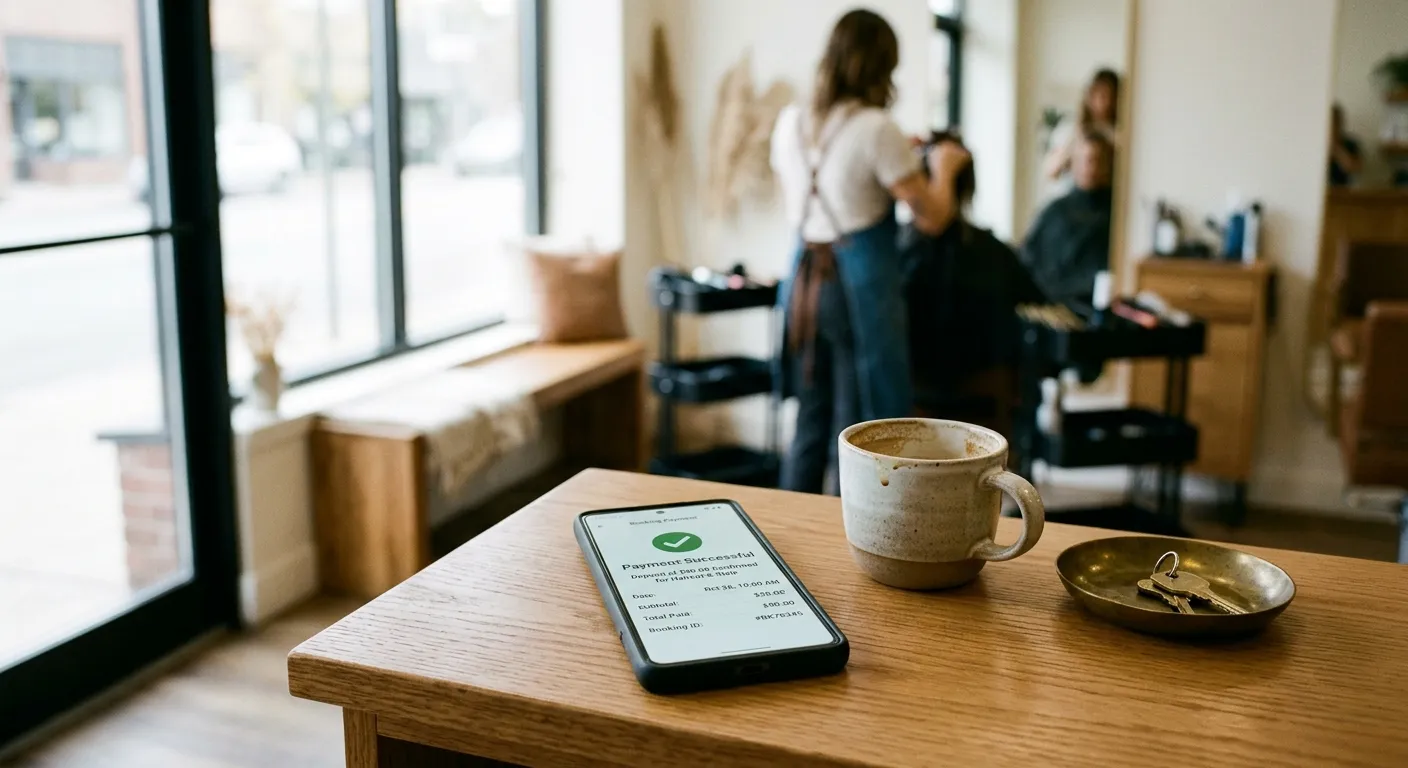
Streamlined mobile checkouts with instant digital wallets convert browsers into confirmed, deposited appointments in under 30 seconds.
To maximize completed checkouts when taking advance deposits on smartphones, apply these core engineering standards:
- Integrate Express Mobile Wallets: Incorporate Apple Pay and Google Pay into your Stripe or Square checkout flow. Digital wallets allow clients to complete a deposit using facial recognition or fingerprint scan in under five seconds without typing card numbers.
- Minimize Form Requirements: Limit required fields during initial booking to essential contact info: Full Name, Mobile Number (for SMS confirmation), Email, and Service Type. Collect detailed intake surveys or vehicle condition details after the reservation is locked in.
- Feature Visible Trust Badges: Display clear security indicators adjacent to the pay button (e.g., "256-Bit SSL Encrypted Processing via Stripe").
- Automate Instant Text Confirmations: Send an immediate SMS containing appointment details, deposit receipt, and a single-click calendar integration link for Apple Wallet and Google Calendar.
When service businesses install custom web applications or fast booking engines, these automated workflows remove telephone back-and-forth and keep daily schedules packed. At Iron Digital, fast custom websites start at $997 for a single page, $1,997 for up to five pages, and $3,997 for up to ten pages. For organizations requiring fully integrated custom client portals, automated scheduling engines, and backend operations platforms, custom software solutions are delivered as fixed-price scopes ranging from $7,997 to $24,997+ depending on exact operational demands.
Which Appointment Businesses See the Biggest Difference?
While almost any appointment-based operator benefits from advance commitment, four core service sectors across Metro Detroit experience immediate jumps in net earnings after launching online deposits:
1. Auto Detailing & Ceramic Coating Studios: Material expenses (ceramic bottles, paint correction pads) and extended labor blocks (4 to 8 hours) make a missed appointment financially painful. Detailing shops that implement a $50 to $100 booking deposit regularly reduce no-show rates from 18% down to under 2%. For operators building brand recognition across suburban corridors and urban centers—much like the commercial developments reshaping downtown Detroit's business district—predictable scheduling is critical for managing technicians and shop overhead.
2. Medical Spas & Aesthetic Clinics: High-demand time slots for aesthetic injectables, laser skin treatments, or body contouring draw high intent but frequent last-minute cancellations if left unconfirmed. A $50 deposit credited toward the appointment balance guarantees patient follow-through.
3. Specialized Home Contractors & Inspection Services: On-site diagnostic visits or project quoting represent unrecoverable drive time and fuel costs. Requiring a $49 consultation deposit screens out window-shoppers while granting serious clients a full credit toward their finalized project invoice.
4. Photography & Creative Production Studios: Reserving physical studio spaces and setting up specialized lighting gear requires extensive preparation. Creative studios using advance deposits keep their production calendars booked weeks ahead. Growing agencies often manage these creative workflows using modernized organizational strategies, similar to teams managing operations from a centralized Detroit headquarters.
Five-Step Action Plan to Implement Online Deposits Today
Upgrading your booking system from unpaid holds to secured online deposits takes minimal setup when executed systematically:
- Establish Your Deposit Threshold: Pick a balanced flat amount ($25 to $50) or percentage (20% to 30%) that matches your average job ticket.
- Configure Payment Gateway Integration: Connect your calendar system (Calendly, Acuity, Boulevard, Vagaro, or a custom Stripe integration) to require card validation prior to confirming the calendar slot.
- Write Concise Policy Messaging: Keep cancellation guidelines under three sentences and display them prominently above the payment button.
- Activate Automated Reminders: According to SMB software industry surveys (2023), automation can save small business owners an average of 10+ hours per week on repetitive administrative tasks. Set up automated SMS text reminders 48 hours and 24 hours prior to scheduled times.
- Audit Mobile Checkout Speed: Complete a test booking on a smartphone. Ensure the entire payment flow finishes in under 30 seconds without visual bugs or slow page loads.
Frequently Asked Questions
Will requiring a booking deposit lower my overall online inquiries?
While asking for a deposit slightly reduces low-intent clicks, overall net revenue increases because uncommitted browsers are filtered out before clogging your calendar. The clients who complete checkout are highly committed, bringing your attendance rate close to 100%.
How should I handle deposits for clients who call on the phone to book?
Send the client an automated SMS or email containing a direct payment link while on the call, letting them complete the deposit on their smartphone in seconds. Alternatively, take card details securely over the phone directly inside your online payment dashboard to lock in the reservation.
What is the best way to handle deposit refunds when a client cancels on time?
Automate refunds directly through your payment processor (like Stripe or Square) whenever a cancellation occurs outside your notice window. Alternatively, offer an instant credit balance toward their rescheduled date to retain the revenue while accommodating their schedule change.
Should I charge a flat deposit fee or a percentage of the total service cost?
Use a flat fee ($25 to $50) for standard, fixed-length appointments like hair styling or routine maintenance washes where total costs are low. Choose a percentage deposit (20% to 30%) for high-ticket services exceeding $300 that require extensive material prep or long labor windows.
Streamline your booking flow and protect your calendar revenue.
Tell us about your current appointment system and where clients run into checkout friction. We will build a fast, high-converting payment workflow tailored to your team.
Start a Project