
Updated September 23, 2026 · Editorial review by Iron Digital MI
← Back to BlogPicture a grant review committee table in mid-November. Three selectors sit in front of neat stacks of paper—or more likely, dual-monitor setups displaying endless PDF submissions. They have forty-eight hours to score eighty-five proposals competing for a single local development grant. They are tired. Their coffee has gone cold.
By proposal thirty, a distinct sensory numbness sets in. It is not caused by the complexity of the projects, but by the overwhelming sameness of the prose. Page after page of text reads like it was translated from a bureaucratic dialect by a friendly, overly eager machine. Every program claims to be a "pivotal turning point" designed to "empower local stakeholders" through a "holistic framework of community-driven solutions."
To an experienced evaluator, these phrases are not signs of professional polish. They are the linguistic red flags of an unedited large language model. Using artificial intelligence is no longer a secret shortcut; it is a baseline operating procedure. For small teams, automation can save small business owners an average of 10+ hours per week on repetitive administrative tasks (Source: various SMB software industry surveys, 2023). That time savings can be the difference between submitting a proposal or missing the deadline entirely. However, if you let the machine write the soul of your proposal, your application will end up in the discard pile. To stand out, you must understand exactly how reviewers detect AI-generated fluff, what parts of your proposal can be safely accelerated by machines, and how to preserve the raw, human credibility that actually wins funding.
Key Takeaways
- AI should be treated as a research assistant and structural guide, never as the final author of your proposal's impact narrative.
- Reviewers immediately flag linguistic patterns like repetitive syntax, excessive adjectives, and passive sentence structures typical of raw AI outputs.
- Your internal team must own the human elements: direct quotes, community relationships, local context, and raw performance metrics.
The Dead Giveaways: AI Tells That Sink Your Application
Reviewers don't need fancy detection software to spot machine-generated prose. The signs are built into the default styling of major language models. When you leave AI-generated text unedited, you leave behind unmistakable structural and lexical patterns that signal a lack of effort and authenticity.
The first giveaway is lexical monotony. Standard LLM outputs rely heavily on a specific suite of words. They write about "testaments," "blueprints," and "pivotal" milestones. They love "fostering" change, "facilitating" dialogues, and "enhancing" capacities. If your grant application uses words like "vital" or "transformative" three times in a single paragraph, a reviewer's internal alarm sounds. This repetitive vocabulary makes the prose feel inflated but empty, failing to convey the concrete details of your actual program.
The second tell is structural predictability. An AI-written paragraph almost always follows an introductory sentence, three supporting clauses separated by predictable transitional adverbs (such as "additionally," "furthermore," or "consequently"), and a neat, bowing conclusion. Human thought is naturally messier. Humans write with varied sentence lengths. Sometimes they use a short, sharp four-word sentence to punch home a point. Sometimes they use a longer, narrative sentence that traces a lived experience. When every paragraph matches the same rhythmic template, the reading experience becomes fatiguing, prompting reviewers to skim over key details.
The third tell is the total absence of friction. Real community development projects, technology rollouts, and business expansions are hard. They involve setbacks, messy logistics, municipal disputes, and complex negotiations. AI writes about these challenges as clean, abstract variables to be solved by a "comprehensive framework." When you scrub the friction out of your proposal, you scrub out the credibility. Reviewers want to see that you understand the ground-level challenges of serving your target demographic. They want to see operational reality, not sanitized perfection.
"Reviewers scan thousands of pages. They aren't looking for the most beautifully structured sentences; they are looking for evidence of actual work, authentic local trust, and direct execution capabilities."
What AI Genuinely Speeds Up (The Smart Workflows)
This doesn't mean you should abandon AI tools. Used strategically, an LLM can cut your proposal preparation time in half. The trick is knowing where to apply the machine and where to apply the human. By focusing your AI use on administrative and formatting workflows, you preserve your energy for the creative, high-impact sections of your application.
First, AI is incredibly effective at drafting compliance checklists and logical frameworks. When you receive a complex request for proposals (RFP) containing dozens of nested requirements, paste the entire text into your LLM. Ask the system to extract every single compliance rule, formatting constraint, and evaluation metric. Command it to generate a structured writing outline built precisely around the reviewer's scoring rubric. This ensures your team never misses a hidden requirement or formats a document incorrectly, saving you from administrative disqualification.
Second, AI excels at data synthesis and summarization. If you have compiled folders of community surveys, historical performance spreadsheets, and local census data, use the system to organize this raw material. Instead of spending hours calculating programmatic trends, paste your raw metrics into the model and ask it to summarize key accomplishments. You can instruct the tool to find specific percentages, isolate year-over-year growth, or format raw data into structured tables ready for insertion into your proposal.
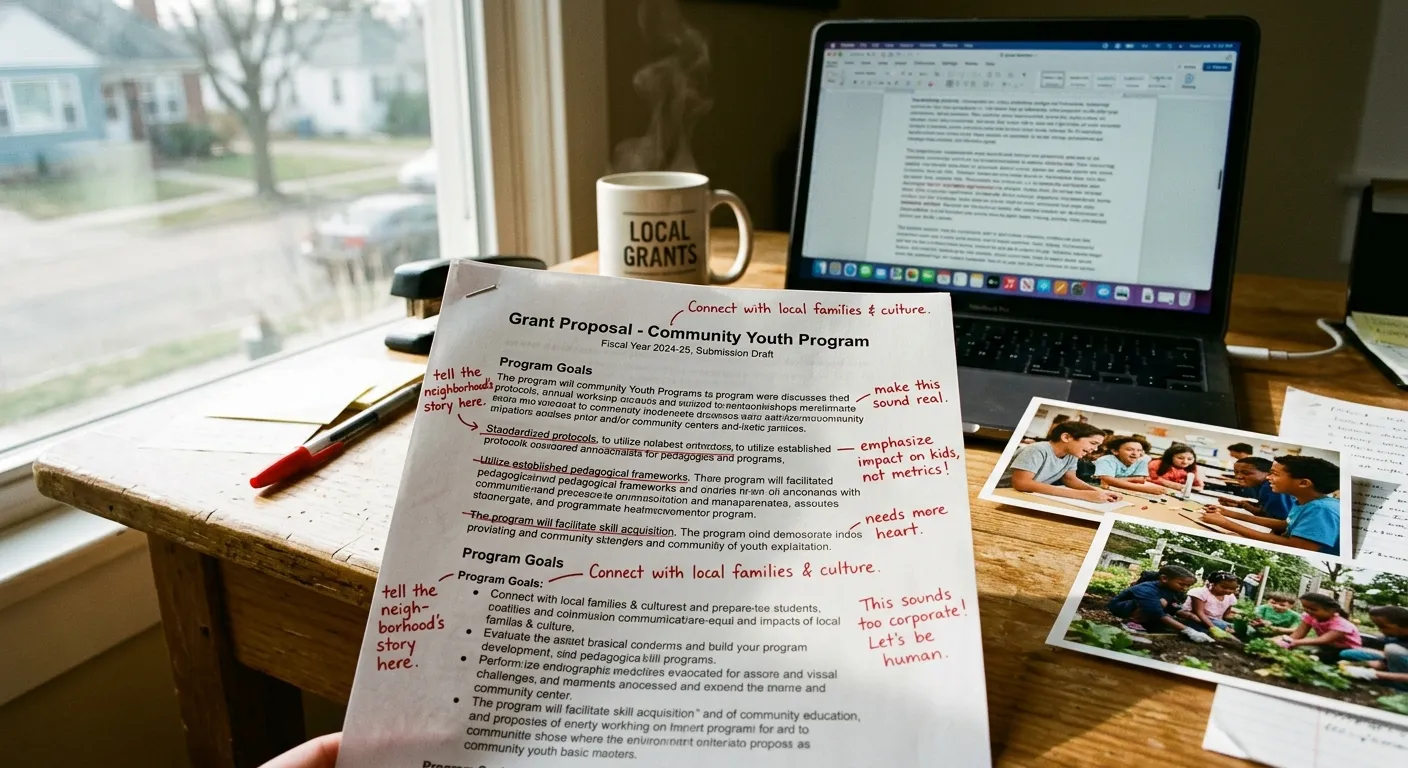
Winning grant proposals combine the efficiency of AI-driven outlines with the irreplaceable, authentic voice of local program staff.
The Sacred Spaces: What Must Come From Your Team
While AI can organize your data and draft your outlines, the programmatic soul of your grant must remain handcrafted. There are sections of your proposal that must never be written by a machine because they require local context, authentic relationships, and direct lived experience.
The first sacred space is the local community narrative. No language model understands the specific dynamics of a neighborhood corridor or the physical reality of local commercial strips. In Detroit, this hyper-local knowledge is what separates winning grants from generic submissions. If you are applying for funding to support community programs, referencing specific street intersections, local partner organizations, and historic community groups is critical. Our look at how neighborhood initiatives require deep local grounding highlights why generic, sweeping copy fails to convince evaluators on the ground.
The second sacred space is qualitative evidence and direct quotes. AI cannot invent genuine human experience. Incorporate raw, unedited quotes from your program beneficiaries, field staff, and local partners. A single, direct quote from a resident who benefited from your services carries more weight than ten pages of polished, AI-generated theory about community empowerment. Leave the grammatical imperfections in those testimonies intact; they provide the emotional weight that proves your project actually matters to real people.
Finally, your unique methodology must be explained in your own words. AI tends to normalize processes, describing your unique intervention in standard terms that make it look identical to every other applicant in the stack. If your organization has developed a specific way of training workers or executing physical projects, your staff must write that section. If you want to understand how to present sophisticated operating structures without losing clarity, read our guide on managing complex, distributed project operations to learn how to structure clear organizational communications.
The Grant Writing AI Playbook
To maximize your writing efficiency while protecting your voice, structure your writing process into clear machine-led and human-led phases. The following table highlights how to divide labor effectively during your next grant submission:
| Proposal Component | AI Assistance Role | Human Staff Requirement |
|---|---|---|
| RFP Compliance & Outline | Excellent. Extracts key requirements and creates structured writing guides. | Reviewing constraints to ensure alignment with operational capacity. |
| Community Need & Data | Good. Synthesizes census statistics and local research documents. | Selecting which data points accurately reflect the real community reality on the ground. |
| Project Narrative & Voice | Poor. Generates cliché, passive, overly optimistic filler copy. | Critical. Handcrafting narratives, client testimonies, and specific local execution details. |
Practical Steps to De-Machine Your Text
Before you submit any proposal that utilized AI assistance, put the draft through a deliberate de-machining review. This process is designed to strip out the digital fingerprints and restore a natural, authoritative human tone.
- Read It Out Loud: Read your draft aloud. If you find yourself running out of breath during a sentence, or if you encounter phrases you would never say to a colleague over coffee, rewrite them immediately. Simplify the structure.
- Purge AI Clichés: Run a search throughout your document for terms like "pivotal," "testament," "holistic," "robust," "catalyze," and "empowerment." Delete these buzzwords and replace them with specific details or direct action verbs.
- Vary Your Sentence Length: Manually break up long blocks of text. Insert short, declarative sentences directly after longer explanatory statements to create natural rhythm and keep the reviewer engaged.
- Inject Local Anchors: Scan your text for generic phrases like "local neighborhoods." Replace them with exact geographical anchors, specific street coordinates, and the names of local partner agencies to ground your narrative.
Ultimately, winning grants are won by showing, not telling. AI can organize the structure and clean up the data, but it cannot replace the years of trust your team has built on the ground. Use technology to clear away the administrative work, and let your authentic mission do the rest.
Proposal & Funding Resources
Organizations and platforms offering support for grant seekers and community innovators:
- Candid (formerly Foundation Center) Comprehensive data on foundations, fundraising training, and grant databases candid.org →
- Michigan Nonprofit Association Resource network supporting Michigan-based community organizations and grant initiatives mnaonline.org →
- TechTown Detroit Providing local workshops, strategy sessions, and support for Detroit business proposals techtown.org →
- New Economy Initiative Grants and support systems specifically geared toward diverse entrepreneurs in Detroit neweconomyinitiative.org →
Frequently Asked Questions
Can grant reviewers detect when I use AI to write my proposal?
Yes, reviewers can easily spot unedited AI copy. While they may not always use automated detection software, the repetitive sentence structures, passive voice, and generic buzzwords typical of language models act as immediate red flags.
What sections of a grant application are safest to write with AI?
AI is highly effective for administrative, non-narrative components. Use it to outline the proposal based on RFP guidelines, format staff biographies, summarize raw community data tables, and generate standard compliance checklists.
How do I make my AI-assisted proposal sound more human?
To remove the machine-like tone, read the draft out loud and simplify complex sentences. Strip away excessive adjectives like 'pivotal' and 'transformative,' replace passive verbs with active ones, and inject specific local names, streets, and direct client quotes.
Will using AI in grant writing hurt our organization's credibility?
It will only hurt your credibility if the final submission feels lazy and generic. If you use AI solely as a structural and editorial assistant while ensuring your staff writes the core impact stories and programmatic details, you will maintain complete credibility.
Building a Detroit tech company and need the digital infrastructure to back it?
From your web presence to your back-end systems, we build what Detroit businesses need to compete at the level the market is moving toward.
Start a ProjectReady to put this into practice? Visit our custom web development page to see how we work.